Thursday, December 23, 2010

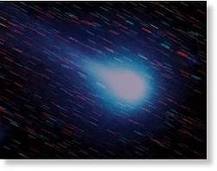
Wanted for Theft: The Comet Sunday Stole from another star


It seems that our sun could be a cosmic thief who most of the comet was stolen from another star, a new study indicated.

Comets are small icy bodies that light up when they near the sun as solar ice they were a bright tail to create to evaporate.

new computer simulations of billions of comets crisscrossing the solar system indicate that most of them originate outside our local area, but it grabbed and pulled by the gravity of our sun later.

Scenario unlike the old model for the evolution of comets, which holds that most of our local comets come from the same area where the sun and planets formed. This region, known as the Oort cloud surrounding the solar system and extends far beyond Pluto.

According to researchers it Levison, an astronomer at the Southwest Research Institute in Boulder, Colorado, but "the standard model can not generate near the amount of comets we see."

"This model says that comets are the dregs of planet formation of our solar system and our planet's gravity boot them to a very great distance, fill the cloud," said Levison. Such a process tends to occur around other stars as well, with each giving rise to their own cloud of comet debris.

But the star may not have been at their initial cloud.

Like the other stars, the sun gave birth in the open star clusters are destroyed from time to time. The cluster usually contains between ten and a thousand stars jammed into a small space, an average radius is not much different from the Oort cloud today. Near the star in the group may have allowed the star to "steal" young comets from each other.

And the stars would not have been the greatest to the most successful thief. As the comet moves far enough away from the star and close enough to the sun, for example, can trap the sun's gravity, even if the parent star is much larger.

If it does not add

The distance of the Oort cloud from the ground makes it difficult to see - let alone pin down the exact number of comets contain. The number of comets that are derived from their observations of the comet, which lights when they passed near the sun.

But based on this data, Levison and his team said there was about 400000000000 comets floating just outside Pluto. For comparison, the conventional model predicts only 6 billion.

"This is ... a big difference," says Levison. "Too big to be explained by errors in the budget is not possible for us to much, so there must be something wrong with the model itself .."

Long period comet orbits that these findings appear to support. they are highly elliptical orbits take them far into the depths of space.

"So they could not have been born in orbit around the sun," says Levison. "They have now formed to other stars, and then here was hijacked."

Comets are generally considered a very good picture of the early solar system, because they spend most of their lives encased in ice. And if some comets come from outside our solar system, they can tell us about their parent stars, too.

"We have the orbits of comets can be studied and their chemical put in the context of and around their stars formed," says Levison. "It's exciting to think we have some" goods "we in the distant star us. Family."


Sunday, December 5, 2010

First Landing Photo: Secrets of the X-37B Aircraft Space Robot Land in California


The mysterious U. S. Air Force's X-37B robotic spacecraft returned to Earth today (December 3) with a successful landing at Vandenberg Air Force Base in California before sunrise.
Air Force officials praised the successful landing X-37B unmanned spacecraft, although its mission remains shrouded in secrecy because of its classified nature. But Vandenberg's 30th Space Wing is not shy of breaking pictures of X-37B vehicle called the Orbital Test Vehicle 1. Looking at the first pictures below:
Nose to Nose: the space X-37B aircraft builder Boeing's released unmanned spacecraft just after landing on December 3, 2010.
spacecraft spent 220 days in space before gliding to a landing early morning at Vandenberg Air Force Base in California.
Home Again: Although the nature of robots, spacecraft X-37B will receive a warm welcome from the crew at Vandenberg Air Force.
Here, if the vehicle appeared to survive after landing procedure on 3 December at 01:16 PT (0916 GMT).
Significant erosion, or changes in color can be seen on top of the thermal insulation blanket that spacecraft.
X-37B in Profile: An Air Force photographer snapped a profile view of the X-37B landing shortly after his 3 December.
X-37B is about 29 feet (9 meters) long and has a wingspan of more than 14 feet (4 meters) across. Standing over 9 1 / 2 feet (3 meters) tall and weighs 11,000 pounds (5,000 kg). For comparison: Two X-37B vehicle in rows on the back of the nose, could fit in the payload bay of NASA space shuttle. Boeing Phantom Works division in Seal Beach, Calif., the spacecraft.
This graphic SPACE.com X 37B illustrate the features and functions of unmanned spacecraft.
Up Close and Personal: A handler vehicle crews dressed in a suit to protect against hazardous materials (such as rocket fuel remaining) robotic spacecraft approaches the X-37B successfully landed after December 3 at Vandenberg Air Force Base in California.
Concept X-37B: This photo released by the Air Force, the spacecraft's nose mysterious X-37B as the recovery crew to take measurements and other readings to December 3 landed at Vandenberg. unique X-37B V-shaped "ruddervators" - which serves as a stabilizer tail - which looks and the air brakes deployed.
Payload Bay Door: Here is the spacecraft X-37B is seen in profile as a post-landing the job ahead. Logo Boeing and the Air Force plane was visible in the stomach can be reused. They appear between the line that describes the payload bay of the X-37B, which is the size of pickup truck beds and can hold experiments, small satellites and the solar panel array that is used for power generation.
Welcome Home: the space shuttle's cargo bay is the X-37B is clearly visible in side view, as the scale of the spacecraft relative to the human
X-37B began life in 1999 as a project of NASA, DARPA office and then transferred to the Pentagon in 2004. Air Force took over in 2006. The mission was launched on 22 April 2010. The purpose of the flight and the cost is classified.
Looking Up: The view side of the X-37B was taken by a photographer Boeing publicly grooved runways at Vandenberg Air Force Base in which robotic spacecraft landed today. Force Vandenberg workers replace hundreds of small steel plates on runwary to do harm to the band X-37B to avoid during landing, according to the Santa Maria Times newspaper.
Job well done: In the back of the first X-37B vehicle on Earth, the Air Force is now looking for the next launch. The Air Force ordered the construction of the two X-37B - the Orbital Test Vehicle 2 - for the mission to launch in spring 2011.


Saturday, October 9, 2010

Water Ice Common on Asteroids, Discovery Suggests


Scientists have discovered water ice on an asteroid for the second time, suggesting that it is more common on space rocks in our solar system than previously thought.

Two research teams have found evidence of water ice and organic molecules on the asteroid 65 Cybele, just six months after discovering the same stuff on a different space rock — asteroid 24 Themis — for the first time. The results suggest that asteroids may have delivered much of these essential materials for life to the early Earth, the researchers said.

"This discovery suggests that this region of our solar system contains more water ice than anticipated," said Humberto Campins, of the University of Central Florida, in a statement. "And it supports the theory that asteroids may have hit Earth and brought our planet its water and the building blocks for life to form and evolve here."

A very thin layer

The researchers analyzed the sunlight bouncing off 65 Cybele, which has a diameter of about 180 miles (290 kilometers) and circles the sun in the asteroid belt between the orbits of Mars and Jupiter.

The teams used two different NASA instruments: the Infrared Telescope Facility atop Mauna Kea in Hawaii, and the Spitzer Space Telescope. The telescopes picked up the telltale signatures of water ice and complex organic solids on the space rock's surface, researchers said.

They didn't find great sheets of ice — the asteroid's ice layer is probably less than one micron thick, Campins told reporters today (Oct. 8) during the 42nd annual meeting of the American Astronomical Society's Division for Planetary Sciences in Pasadena, Calif.

The ice layer is probably also very unstable, Campins said, so it has probably only coated the space rock for a few thousand years or so. The research team isn't sure where it came from, but one possibility is the asteroid's subsurface.

If the ice did indeed migrate up from 65 Cybele's interior, the water could be primordial, Campins said — leftovers from the early stages of our solar system's formation. But that's just speculation at this point.

"We have a detection, and we're starting to figure out what the physical characteristics and abundance of this ice are," Campins said.

Changing our view of asteroids

The discovery of water ice on 24 Themis — announced in April 2010 by the same two research teams — changed many scientists' perspectives on asteroids. [5 Reasons to Care About Asteroids]

Asteroid 24 Themis resides in the same region of the asteroid belt as 65 Cybele. Many scientists had thought asteroids in this part of the belt were too close to the sun to carry water ice.

These asteroids may have been ice-covered long ago during the solar system's youth, the thinking went, but their surface water should have evaporated by now.

Finding water ice on such space rocks now, 4.6 billion years after the solar system's birth, suggests that asteroids may have delivered much of the water that fills Earth's oceans — and perhaps some of the complex organic molecules that served as the building blocks of life here, scientists have said.

Filling the oceans?

Earth has experienced a violent history, having been bombarded by space rocks throughout much of its life. In particular, a large rock is thought to have crashed into Earth some 4.5 billion years ago, knocking off a giant chunk of material that eventually became our moon.

At that point, the collision would have heated things up so much that any water on Earth would have been vaporized. So, how did the oceans form?

Comets hold a great deal of water ice, but they are not ideal candidates for filling up Earth's early oceans. Comet water tends to be of a different nature — its atoms are in a different configuration — than most of the water on Earth, scientists have said.

The new results strengthen the case for asteroids as water-bearers for the early Earth. In the solar system's early days, asteroids likely slammed into Earth far more frequently than they do today, researchers have said. If many asteroids were even just a little icy, the Earth could have received quite a drenching, they added.

The discovery may also be a boon to NASA's new space exploration program, which is aiming to send astronauts to visit a near-Earth asteroid by 2025.

The research has been accepted for publication in the journal Astronomy and Astrophysics.

Source: www.space.com


Tuesday, October 5, 2010

Eau! 'Perrier Ocean' Could Give the Kick to Saturn Moon's Geysers


The mysterious icy jets erupting from Saturn's moon Enceladus may have their roots in a bubbly "Perrier ocean" flowing beneath the moon's frozen surface, a new study finds.

This salty subsurface sea could feed violent geysers on Enceladus, supplying them with water, gas, dust and heat before sinking back to the dark depths.

"The realization that there's a circulation system inside of Enceladus is something that's a new way of thinking," Dennis Matson, a researcher with NASA's Jet Propulsion Laboratory, told reporters Monday (Oct. 4). "But as you know, Enceladus has unique properties."

Matson discussed the Enceladus find at the American Astronomical Society's Division of Planetary Sciences meeting in Pasadena, Calif.

Mysterious geysers on an icy world


The ice geysers of Enceladus were first spotted in 2005 by NASA's Cassini spacecraft, which revealed jets of icy particles erupting from the moon's southern polar region. Enceladus is Saturn's sixth-largest moon.

The discovery jolted many astronomers — as did other evidence of a hot spot around Enceladus' south pole — showing that the small, frozen and presumably dead moon is geologically active.

More recent observations from Cassini have shown that the geysers are associated with Enceladus' "tiger stripes" — huge fissures in the moon's ice-covered surface.

Cassini has also found that the geysers contain water vapor, sodium salts, potassium salts and carbonates, suggesting that a sea of liquid water flows beneath the moon's icy crust.

The probe's observations revealed huge amounts of heat flowing through the tiger stripe region — about five times more heat per unit area than flows through Earth's geologic hot spot, Yellowstone National Park, scientists have said.

Such finds further intrigued scientists, but they didn't fully explain the fundamental nature of Enceladus' geysers or what was feeding them. The new results could help flesh out that explanation.

A heat-transferring sea

Matson and his colleagues came up with a computer model that accommodates much of what is known about the geysers of Enceladus. Their findings support the supposition that a salty sea flows under the moon's surface.

This ocean has gases dissolved in it, the theory goes. As the seawater flows up to and through the tiger stripe fissures, its pressure drops and the gases bubble up, Matson said — making the ocean fizzy, like Perrier. The relatively warm water and expanding gas feed the jets.

When the bubbles pop, they throw off a fine spray that contains salt and other materials, which Cassini spotted in Enceladus' plumes. Then the seawater, having dumped much of its warmth on the moon's surface ice, cools and sinks back through cracks, rejoining the ocean and its heat-transferring circulation system.

"Until now, how you got so much heat out was a big, big problem," Matson said.

The model doesn't require much dissolved gas in the "Perrier ocean" to work — only 1 or 2 percent, researchers said. And it explains the geyser phenomenon pretty well, including the ultimate source of some of the materials ejected in the plumes.

"A liquid ocean would be in contact with the rocky core" of Enceladus, said Linda Spilker of the Jet Propulsion Laboratory, Cassini deputy project scientist. As it flows past that core, the sea could pick up elements like sodium and potassium, she added.

Source: www.space.com


Friday, October 1, 2010

A new proof of Icebergs in the Ocean Planet Mars Cold


Ancient Mars once had surprisingly frigid primeval oceans complete with their own icebergs, new evidence suggests.

There are currently two leading ideas for what the climate of ancient Mars might have been like.

One is that it was cold and dry, contending that valley networks and other geological features suggestive of liquid water in Mars' past were essentially results of bursts of heat confined in space and time, suggesting that Mars could not have sustained oceans. The other is that Mars was once warm and wet, implying that it could once have supported lakes, seas and rainfall for long periods.

Now researchers have found evidence of icebergs on Mars, supporting a third idea of the Red Planet's ancient climate — that of a cold and wet Mars, governed by oceans or seas covered partly in ice, as well as glaciers and massive polar caps.

Boulder and craters

To peer into Mars' climatic past, scientists focused on the flat, smooth, featureless Martian lowlands, which some have equated to an ancient ocean basin.

However, images captured by the HiRISE camera aboard NASA's Mars Reconnaissance Orbiter revealed the presence of boulders about 1.5-6.5 feet (0.5-2 meters) across, as well as chains of roughly one or two dozen craters measuring 330-1,300 feet (100-400 meters) wide scattered throughout the northern plains. Both these details are hard to reconcile with the notion of fine-grained sediments deposited on a deep ocean basin, and had been used to cast doubts on the concept of an ocean on Mars.

Now astrobiologist Alberto Fairen at the SETI Institute and NASA Ames Research Center and his colleagues suggest the presence and distribution of these boulders and chains of craters could have been caused by rock fragments carried by icebergs, a common process on Earth.

They suggest glaciers in the highlands could have eroded the terrain, transporting rock within them and on their surfaces. Armadas of icebergs would have formed at the edges of glaciers as they melted and broke apart, which could then float thousands of miles on the ocean before they disappeared, depositing rock downward.

Also, on Earth, when icebergs scrape against the ocean floor, they can rain boulders down in clumps, which could explain boulder clusters up to about a mile (1.6 km) wide that scientists have seen on Mars. In addition, when icebergs roll along the sea floor on Earth, they can generate strings of dents, perhaps explaining the chains of craters seen on the Martian lowlands.

Seas or oceans

If there were icebergs, then there were open and sizable bodies of stable liquid water on the surface of Mars, Fairen said.

"The size of the water bodies may have ranged from several local seas to a single hemispheric ocean, and they may have been continuous in time or episodic," he told SPACE.com.

Some might suggest that the scattered boulders were deposited by so-called periglacial processes, Fairen said — that is, processes that take place at the edges of glaciers. However, such processes cannot give a satisfactory explanation for the boulder clusters that HiRISE also saw, he noted.

Others have also suggested that the crater chains were formed by volcanic processes.

"But our analyses can discard this hypothesis, especially because all the craters within one chain are almost identical in shape and dimensions, and that's neither expected nor usual in a volcanic process, but is expected if all the craters in the chain are carved by the same iceberg," Fairen explained.

Fairen added that scour marks some 0.6 to 3 miles (1 to 5 km) long seen in the northern plains and Hellas Basin of Mars could be evidence of icebergs as well. These could have been carved by the keels of icebergs scraping against the ocean floor.

"The scours are the most clear evidence for icebergs that we are finding," he said.

Fairen and his colleagues detailed their findings at the 2010 Astrobiology Science Conference in April.


Friday, September 24, 2010

Spring occurred in Northern Titan


The clouds are clearing on Titan as spring takes hold in its northern hemisphere, signaling a shift in the weather patterns on Saturn's largest moon, a new study finds.

Titan is poised for a mostly sunny spring, one that will last seven Earth years, researchers have found. Seasons on Titan last so long because it takes the moon and Saturn about 30 years to orbit the sun

Scientists analyzed data from the last six years of observations by NASA's Cassini spacecraft to piece together how Titan's weather cycle works. They found that conditions have changed since August 2009 — when the sun was directly over Titan's equator during its latest equinox.

"The clouds at the south pole completely disappeared just before the equinox, and the clouds in the north are thinning out," study leader Sebastien Rodriguez of the Universite Paris Diderot said in a statement. "We are expecting to see cloud activity reverse from one hemisphere to another in the coming decade as southern winter approaches."

Rodriguez and his colleagues said their findings match predictions by computer models. They presented their results at the European Planetary Science Congress 2010 in Rome on Sept. 22.

On Titan, it rains methane

Titan and its weather have intrigued scientists for decades. Some think Earth resembled Titan before life took hold — only not nearly as cold. Titan's surface averages 290 degrees below zero Fahrenheit (minus 179 degrees Celsius).

Titan has a thick, nitrogen-rich atmosphere, and its surface features have been carved by the action of liquid hydrocarbons like methane, which is the chief component of natural gas here on Earth. Methane rain drizzles from Titan's clouds, pooling in frigid liquid lakes.

To better understand Titan's weather, Rodriguez and his team used data gathered by the Cassini spacecraft since July 2004. They studied about 2,000 cloud images Cassini snapped between then and this past April, when Titan's seven-year spring began in the northern hemisphere.

In Cassini's early images, clouds gather at Titan's north and south poles, as well as in a narrow belt in the southern hemisphere. But in recent images, with the northern spring taking hold, cloud cover has decreased substantially at both poles.

Seasons change on Titan

These findings match predictions by computer models developed by other researchers in the past. Rodriguez and his team combined those models with the actual Titan observations to understand Titan's evolving cloud patterns.

Different cloud-formation mechanisms are likely at work in the different hemispheres, the researchers said.

During the northern winter, ethane and aerosols probably stream down from high in Titan's stratosphere, generating clouds near the north pole. These clouds are made of ethane, and they form at altitudes of 19 to 31 miles (30-50 km).

In the southern summer, on the other hand, methane-rich air wells up from Titan's surface. This action forms methane clouds at middle to high latitudes, the scientists said.

As Titan's seasons turn, these cloud-formation actions and patterns may flip from one hemisphere to the other, the researchers said.

They can see for themselves.

In February the Cassini mission was extended to May 2017, meaning Rodriguez and his team can get cloud-cover data all the way from mid-winter to mid-summer in Titan's northern hemisphere.

"We have learned a lot about Titan's climate since Cassini arrived at Saturn, but there is still a great deal to learn," Rodriguez said. "With the new mission extension, we will have the opportunity to answer some of the key questions about the meteorology of this fascinating moon."


There is a Spectacular aurora at Saturn Shines


Earth isn't the only planet in the solar system with a dazzling northern lights show. A new video from Saturn shows spectacular aurora on the ringed planet, revealing new details about how the phenomenon works.

The Saturn aurora movie was made from images collected by NASA's Cassini spacecraft's visual and infrared mapping spectrometer (VIMS) instrument.

"Cassini's instruments have been imaging the aurora in magnificent detail, but to understand the overall nature of the auroral region we need to make a huge number of observations -- which can be difficult because Cassini observation time is in high demand," said study leader Tom Stallard of the U.K.'s University of Leicester in a statement. "However, there are VIMS observations of numerous other scientific targets that also include auroral information. Sometimes the aurora can be clearly seen, sometimes we have to add multiple images together to produce a signal."

As a whole, the collection of observations should help build up a better understanding of how auroras happen across the solar system, he said.

Stallard will present preliminary results from his study at the European Planetary Science Congress in Rome on Friday (Sept. 24).

In the new Cassini video, the aurora can clearly be seen to vary significantly over the course of a Saturnian day, which lasts around 10 hours and 47 minutes. On the noon and midnight sides (to the left and right respectively) the aurora can be seen to brighten significantly for periods of several hours, suggesting the brightening is connected with the direction of the sun.

Other features can be seen rotating along with the underlying planet, reappearing at the same time and the same place on the second day. This suggests that they are directly controlled by the direction of Saturn's magnetic field, researchers said.

As with Earth's northern and southern lights, the auroras on Saturn are created when solar wind particles are channeled into the planet's magnetic field toward its poles. There, they interact with electrically charged gas (plasma) in the upper atmosphere and emit light.

However, aurora features on Saturn can also be caused by electromagnetic waves generated when its moons move through the plasma that fills the planet's magnetosphere.

To date, Stallard and his colleagues have investigated some 1,000 images from the 7,000 that Cassini's VIMS instrument has recorded of Saturn's auroral region.

"Saturn's aurorae are very complex and we are only just beginning to understand all the factors involved," Stallard said. "This study will provide a broader view of the wide variety of different auroral features that can be seen, and will allow us to better understand what controls these changes in appearance."


Thursday, September 23, 2010

Amazing Views of Jupiter and Uranus Thrill Skywatchers


The rare cosmic triple play of Jupiter, Uranus and the full moon this week is dazzling amateur astronomers with a bright night sky show.

"I never grow tired of viewing the planets," skywatcher Jimmy Eubanks told SPACE.com, adding that Jupiter is a longtime favorite. He photographed Jupiter and Uranus from his front lawn in Boiling Springs, S.C., on Monday (Sept. 20) during Jupiter's closest approach.

Jupiter, Uranus and the nearly full Harvest Moon met in a rare cosmic lineup late yesterday (Sept. 22), just two days after Jupiter made its closest approach to Earth in nearly 50 years. Wednesday night's sky show also occurred on the equinox, marking the official start of the fall season in Earth's Northern Hemisphere, and spring in the south.

If you missed the sky show, don't despair. Jupiter will continue to be a bright skywatching target for several weeks, according to the skywatching website Spaceweather.com.

Through a telescope, the brilliant bands of color from the turbulent atmosphere of Jupiter were unmistakable, Eubanks said. At the time, Jupiter was 3.95 astronomical units, or AU, from Earth. One AU is the average distance between Earth and the sun, about 93 million miles (150 million km).

"It's quite a surreal experience to view an object that is so far away and know that you are watching weather on another planet," Eubanks said. He used a Meade 8-inch SCT telescope to capture his photos.

In Arizona, amateur astronomers were also treated to clear skies, serving as the perfect stage for Jupiter and Uranus.

Photographer Jin Lu in Tempe did not expect a good view of the planets. The telescope he and his friends were modifying with a new camera wasn't ready yet. But he pointed his Nikon D90 camera with an 18-105 mm lens to see what he could see on Sept. 19.

The result, he said, was amazing.

"Jupiter, its moons and Uranus were just there," Lu said, adding that the weather was perfect for viewing. "The fourth moon, Europa, was too close to Jupiter and could not be seen."

Lu also snapped this long-exposure photo of Jupiter, which shows the planet's movement across the sky in front of a sea of stars.

In the Phoenix suburb of Gilbert, Ariz., skywatcher Pat Jameson did not have a telescope, but still made a point to look for Jupiter after reading about its close approach on SPACE.com.

"I had never pointed binoculars at any celestial body other than the moon ... and I was stunned to see three pinpoints in a straight line through the middle of Jupiter," Jameson said, adding that it was clear they were Jupiter's moons. "Amazing, with all the ambient light of the city, I could still see them. How cool is that?"

Source: www.space.com


Microbes With the Right Stuff? Synthetic Life Could Make Mars Trips Easier


When packing for a manned mission to Mars or the moon, the best thing to bring may not be food or fuel, but specially designed organisms that can create those things for you.

Scientists are researching the possibility of engineering synthetic organisms that would use the resources available in the solar system to create the supplies astronauts would need to survive on another planet.

"Personally I'm interested in space settlement," said John Cumbers, a graduate student at NASA's Ames Research Center in Moffett Field, Calif., who is researching synthetic microbes. "I think we have two choices: We can either go into space and be living inside a tin can, or we can be going into space and recreating in space some of the beauty of nature we have here on Earth."

Cumbers said he wasn't advocating terraforming, or completely restructuring the surface of a planet to mimic Earth, but rather using bioengineered organisms in a planned and contained way to make life easier in an alien environment.

"I think there's a lot that we can do that's productive with biology without having to release organisms in an unplanned fashion," Cumbers told Astrobiology Magazine.

The dangers of 'Frankenlife'


Even with careful planning, this concept could bring risks, as some experts warn against creating "Frankenlife" that could become an invasive species with unintended consequences for humans or the alien environment, including any native life.

However, other scientists advise reining in fears.

"I don't think this would be particularly hazardous," said Chris McKay, a planetary scientist at Ames who is not involved in Cumbers' project. "The sort of organisms that would be good at doing mineral extraction – acidophiles, for example -- are not the type of organisms that cause disease."

And, he said, these synthetic organisms would present no more risk of contaminating the search for alien life than would the normal microbes being carried by humans and spacecraft.

"In any case, we will have to learn how to tell the difference between contamination from Earth and alien life," McKay said.

Making life easier


To design an organism for use on another planet, researchers want to mix and match desired qualities from multiple species. For example, they might start with a species that can do something useful, such as processing materials into biofuels or food. But this species might not be fit for a harsh environment such as on the surface of Mars, where there is no atmosphere to block harmful ultraviolet radiation, and where temperatures can reach frigid depths.

To fix that problem, researchers might want to give that organism genes from extremophile life — species on Earth that are adapted to extreme environments and are well-suited to tolerate cold and resist UV radiation.

Scientists have already achieved some successes in this quest. Cumbers described an experiment in which researchers genetically engineered an E. coli bacterium to survive at lower temperatures than it normally does. They accomplished this by transferring into an E. coli cell the genes from a chaperone from a cold-tolerant organism found in sea ice. A chaperone is a protein that helps other proteins to fold correctly.

One goal that could prove useful for space exploration is creating a synthetic version of spirulina, a dietary supplement made from microscopic algae produced by cyanobacteria. Spirulina is a complete protein, meaning it contains all of the essential amino acids humans need in their diet. That makes it an ideal food to bring on a space mission.

But spirulina generally grows in open ponds in the warm waters of Hawaii – so adapting it to life on, say, the moon is an engineering challenge.

Packing for space

One reason bioengineered organisms are so appealing for space travel is that they could open up a lot of room in astronauts' suitcases. The more supplies space travelers can produce once they arrive at their destination, the less they have to pack on the spacecraft.

"For manned missions to the moon or Mars we're going to have to take nearly everything with us, at least at the beginning," Cumbers said. "If we have this new technology where we can take the complete genome of an organism and send it into space — and can have that single cell replicate from the resources it finds around it rather than resources we've taken with us — then we've started to tackle the problem."

Cumbers presented his work with Lynn Rothschild, his adviser at Ames, at the Astrobiology Science Conference in League City, Texas, in April.

Source: www.space.com


Mars Rover Opportunity Approaching Possible Meteorite


PASADENA, Calif. -- Images that NASA's Mars Exploration Rover Opportunity took at the end of an 81-meter (266-foot) drive on Sept. 16 reveal a dark rock about 31 meters (102 feet) away. The rover's science team has decided to go get a closer look at the toaster-sized rock and determine whether it is an iron meteorite.

"The dark color, rounded texture and the way it is perched on the surface all make it look like an iron meteorite," said science-team member Matt Golombek of NASA's Jet Propulsion Laboratory, Pasadena, Calif. Opportunity has found four iron meteorites during the rover's exploration of the Meridiani Planum region of Mars since early 2004. Examination of these rocks has provided information about the Martian atmosphere, as well as the meteorites themselves.

The newfound rock has been given the informal name "Oileán Ruaidh" (pronounced ay-lan ruah), which is the Gaelic name for an island off the coast of northwestern Ireland. The rock is about 45 centimeters (18 inches) wide from the angle at which it was first seen.

Opportunity has driven 23.3 kilometers (14.5 miles) on Mars. The drive to this rock will take the total combined distance driven by Opportunity and its twin, Spirit, to more than 31 kilometers (19.26 miles).

JPL, a division of the California Institute of Technology in Pasadena, manages the Mars Exploration Rover mission for the NASA Science Mission Directorate, Washington. Opportunity landed on Mars in January 2004 for what was planned as a three-month mission. For more information about the mission.

Source:www.nasa.gov


Hubble Telescope Captures Heavenly Vision of Lagoon Nebula


A majestic new image from the Hubble Space Telescope reveals billowing waves of glowing gas and dust at the heart of a bright and active star-forming nebula in deep space.

The delicate-looking clouds in the Lagoon Nebula are sculpted by the intense radiation from hot young stars.

The whirls of hydrogen gas are slowly collapsing to form stars, whose bright ultraviolet rays illuminate the surrounding gas in a distinctive shade of red.

The wispy tendrils and crashing wave-like features are caused by ultraviolet radiation's ability to erode and disperse the gas and dust into the distinctive shapes that are visible in the image.

Hubble's Advanced Camera for Surveys captured the dramatic view of the Lagoon Nebula.

The Lagoon Nebula is located more than 4,000 light-years away from Earth, in the constellation Sagittarius (the Archer). It is a vast stellar nursery that stretches about 100 light-years wide. One light-year is the distance light travels in one year, about 6 trillion miles (9.7 trillion kilometers).

This hotbed of star formation earned its name because of a wide, lagoon-shaped dust lane that crosses the glowing gas of the nebula. The structure is prominent in wide-field images, but cannot be seen in this new close-up.

In recent years, astronomers probing the secrets of the Lagoon Nebula have found the first unambiguous proof that star formation by accretion of matter from the gas cloud is ongoing in this region.

Young stars that are still surrounded by an accretion disk will occasionally shoot out long wisps of matter from their poles.

Evidence of these jets, which are called Herbig-Haro objects, have been found in the Lagoon Nebula in the last five years, which provides strong support for astronomers' theories about star formation in such hydrogen-rich regions.

The Lagoon Nebula has been observed by astronomers for centuries, so the new Hubble photo is the latest in a long line of observations. In the 18th century, French astronomer Charles Messier included the object in his famous astronomical catalogue, dubbing the nebula with an alternate name: Messier 8.

Source: www.space.com


Wednesday, September 22, 2010

Distant Spiral Galaxy May Reveal Clues About Our Milky Way


A beautiful spiral galaxy 60 million light-years from Earth could help astronomers better understand our own Milky Way because of a trademark central bar-like structure.

The galaxy, NGC 1365, is one of the most-studied barred spiral galaxies. It is sometimes called the Great Barred Spiral Galaxy because of its strikingly perfect form.

Now, a new photo released by the European Southern Observatory today (Sept. 22) shows the galaxy in exacting detail, and may help astronomers who are trying to determine if our own Milky Way contains a central bar. [New photo of the Great Barred Spiral Galaxy.]

Barred galaxies like NGC 1365 are actually quite common, scientists said. According to recent estimates, two thirds of spiral galaxies are barred, and recent observations have contributed evidence of a bar in the Milky Way.

Astronomers have used NGC 1365 to study how spiral galaxies form and evolve. By examining the complex flow of material within the galaxy, researchers can pinpoint how these processes affect the reservoirs of gas from which new stars can form.

Galaxy bar exam

The galaxy NGC 1365 has a straight bar packed with stars at its center, with two visible outer spiral arms. The entire galaxy is laced with delicate dust lanes, and close to the center is also a second spiral structure.

The new image of the galaxy was taken with the powerful HAWK-I camera on ESO's Very Large Telescope at the Paranal Observatory in Chile. It was captured in infrared light, which cuts through the dust that obscures parts of the galaxy when viewed in visible light.

The photo reveals a clear glow from the vast number of stars that are located in both the bar and spiral arms.

NGC 1365 is located within the constellation of Fornax (the Furnace). The entire galaxy, including its two huge outer spiral arms, spans approximately 200,000 light-years wide. One light year is the distance light travels in one year, or about 6 trillion miles (9.7 trillion km).

A bar in space

The huge bar structure within NGC 1365 disturbs the shape of the galaxy's gravitational field, which causes regions of gas to compress and trigger star formation. Many huge young star clusters trace out the main spiral arms and each contains anywhere from hundreds to thousands of bright young stars that are less than 10 million years old.

In the photo, most of the tiny clumps that are visible are actually star clusters, but the galaxy is too remote for single tars to be seen individually.

The galaxy's bar consists primarily of older stars long past their prime, but many new stars are born in the stellar nurseries of gas and dust in the inner spiral close to the nucleus.

The bar also funnels gas and dust gravitationally to the very center of the galaxy, where astronomers have found evidence to support the presence of a supermassive black hole, well hidden among myriads of intensely bright new stars.
Source: www.space.com


Tuesday, September 21, 2010

Moon Phobos: A Chip Off The Martian Block


Scientists have long wondered where Mars’ two moons, Phobos and Deimos, came from. The leading theories: They’re asteroids snagged by Mars' gravity from the outer part of the main asteroid belt which lies between Mars and Jupiter; they formed from debris that settled into orbit around Mars after an asteroid or comet smashed into the planet; or they formed from the remnants of a prior moon that had been ripped apart by tidal forces.

New evidence suggests you can kiss the captured-asteroid theory good-bye, say astronomers who presented a compositional analysis on Phobos drawn from data collected by two Mars-orbiting science probes.

The scientists say materials in Phobos, the larger of the two moons, don’t match up with the carbon-rich materials found in meteorites that are tied to asteroids from the middle part of the asteroid belt. Instead, they found a type of mineral known as phyllosilicates on the moon’s surface, concentrations of which are particularly high northeast of the moon’s largest impact crater.

“This is very intriguing as it implies the interaction of silicate materials with liquid water on the parent body prior to incorporation into Phobos,” Marco Giuranna, with Istituto Nazionale di Astrofisica in Rome, said in a statement.

The mineral could have formed on Phobos, but that would mean the moon had enough heat to keep liquid water stable, he added.

The scientists also found other minerals on Phobos that appear to match the types of minerals found on Mars. And, they determined that Phobos, which orbits about 3,700 miles from the planet's surface, is rather spongy, unlike denser material from meteorites that are associated with asteroids. A porous asteroid probably wouldn’t have survived getting captured by Mars, the astronomers point out.

The research was presented this week at the European Planetary Science Congress in Rome.

Phobos is the target of a joint Russian-European sample return mission scheduled for launch next year.

(Image: Phobos, a chip off the home world? Credit: NASA/JPL/University of Arizona.)

Source: http://dsc.discovery.com


Information And Technology Copyright © 2010 IT is Designed by hantu-facebook