Sunday, April 24, 2011

Mac vs. PC: The stereotypes may be true


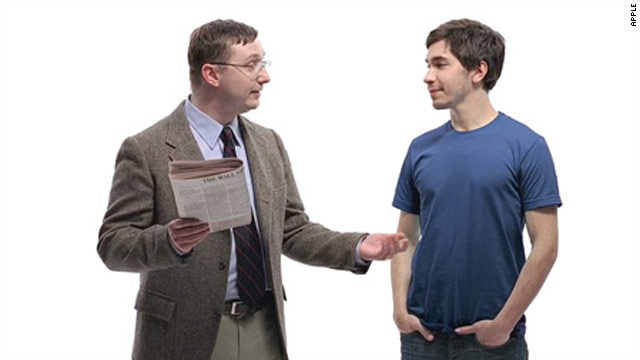
Remember those Apple ads that cast the Mac as a 20-something, self-satisfied hipster while the PC was portrayed by an older, square-looking guy in a brown suit?
Well, those characterizations, unfair as they may be, appear to have some truth to them.
An unscientific survey by Hunch, a site that makes recommendations based on detailed user preferences, found that Mac users tend to be younger, more liberal, more fashion-conscious and more likely to live in cities than people who prefer PCs.

Of the 388,000 Hunch users who responded to a question about computer loyalty, 52% identified themselves as PC people as opposed to 25% who said they are Mac devotees. Hunch then cross-referenced those responses with answers to other questions to draw cultural distinctions between the rival Mac and PC camps.
The results suggest Mac users can be seen, depending on your perspective, as bolder and more creative -- or elitist and more pretentious.

The report found that 67% of Mac users have a college or advanced degree, as opposed to 54% of PC users. Mac loyalists are 80% more likely than PC users to be vegetarians, and, unlike PC fans, would rather ride a Vespa scooter than a Harley.

PC users' tastes trend towards casual clothes, tunafish sandwiches, white wine, Hollywood movies, USA Today and Pepsi. Mac users prefer designer or vintage duds, hummus, red wine, indie films, The New York Times and (we're not making this up) San Pellegrino Limonata.

Mac users also are more likely to describe themselves as computer-savvy and "early adopters." PC users tend to describe themselves as better at math and less likely to throw frequent parties.
"I fit the typical Mac user on every count. Guess I'm not as unique as I thought. Depressing," wrote one commenter on Hunch's blog.

Since Hunch's first survey of Mac vs. PC users in November 2009, Apple has ridden the success of such high-profile products as the iPad and iPhone 4 to become the world's most highly valued tech company. Despite that hot streak, Hunch found that slightly more people in its new report -- 52%, up from 50% a year and a half ago -- now identify themselves as PC users.


Sunday, September 26, 2010

RIM and Samsung should avoid head-on Apple clash


A year ago, industry insiders debated whether a market existed for a device to bridge laptops and smartphones. Now, Samsung Electronics (005930.KS) and Research In Motion (RIM.TO) will be the latest to respond to Apple's gadget.

The iPad attracts many buyers with its sleek interface and i-Tunes music, video and software applications. Business people also use it as a portable display for presentations.

Ahead of BlackBerry maker RIM's expected unveiling of a tablet computer next week, analysts say RIM and its rivals will not succeed unless they offer lower prices or address a segment Apple has overlooked.

"We've yet to hear a convincing story about what the potential is beyond Apple," said CCS Insight analyst John Jackson. "The next successful tablet story will be one that doesn't try to take on Apple directly."

RIM plans to debut the BlackPad at a developers' conference starting Monday, according to a Wall Street Journal report. The device is expected to have a 7-inch touchscreen, which would be smaller than the iPad, and at least one camera.

It is expected to connect to the Internet via short-range Wi-Fi networks found in homes, offices and cafes. Outside Wi-Fi, the only way to connect BlackPad will be to tether it to a BlackBerry phone, according to the report.

It could appeal to cost-conscious customers reluctant to pay additional cellular service fees on top of their phone's data service charge. IPad users pay separate cellular service fees from $15 a month upward.

Several analysts said the lack of a direct cellular link would limit sales for RIM, which had 50 million BlackBerry users by the end of August.

The lack of a cellular service fee may also leave mobile network operators, RIM's main distributors today, without much incentive to promote the device.

"I have my doubts as to whether their tablet will succeed," said Morgan Stanley analyst Ehud Gelblum.

COURTING CONSUMERS

RIM has been successfully courting consumers with new BlackBerrys in recent years. But since businesses are key customers, RIM's best chance may be a tablet specifically for them, said Carmi Levy, an independent technology analyst.

"What I believe RIM is trying to achieve with the BlackPad is not to release a be-all end-all consumer product, but to release a very compelling enterprise product that also has crossover appeal to consumers," said Levy.

Aside from Apple and Samsung, RIM will also compete with rivals such as Dell Inc (DELL.O), which has developed at least two tablets, and Hewlett-Packard (HPQ.N) and Motorola Inc (MOT.N), which plan tablets for 2011.

Some analysts say Samsung's Galaxy Tab is the most credible iPad rival, given it is not only smaller but -- perhaps more importantly -- the Korean conglomerate has forged partnerships with the top four U.S. mobile carriers and with media companies which are providing programing for its Media Hub service.

Nick DiCarlo, Samsung's U.S. director of product planning, listed three features that trump iPad: cameras for two-way video chat, support for Adobe Systems Inc (ADBE.O) Flash software and a compact size that fits in a suit pocket.

"No one of them by themselves would be enough, but all together, they're special," DiCarlo said in an interview.

DiCarlo also pointed to Samsung's media partners: NBC Universal and Viacom's (VIAb.N) Paramount and MTV, which brings hit shows like Jersey Shore. Time Warner Inc (TWX.N) and CBS Corp (CBS.N) are also in talks with Samsung to provide video for Galaxy Tab, according to two sources familiar with the matter.

However, iPad is backed by Apple's long-established iTunes digital media store -- which has the industry's largest library of 250,000 mobile applications. Samsung is depending on Google Inc's (GOOG.O) far smaller Android software store.

Thus, pricing of the Galaxy Tab and its connection services will be crucial, according to analysts who say any iPad rivals need to sharply undercut Apple to entice consumers.

Samsung has not released U.S. pricing for the device as carriers will set the price. But if its suggested price in other markets is any guide, it looks like the device will be more expensive than iPad unless carriers subsidize it.

The company had said the suggested retail price in Finland will be 949 euros ($1,278), well above the iPad's $629 tag.

U.S. operators typically subsidize phones for customers who commit to long-term contracts. When carriers get exclusive rights to sell a device, they promote it more heavily.

But since the Tab will not be exclusive, Current Analysis analyst Avi Greengart said no carrier will "spend outsized marketing budgets promoting Galaxy Tab because they're not likely to get outsized benefits."

DiCarlo said marketing will be a collaborative effort with carriers. And Dan Hesse, head of No 4 operator Sprint Nextel (S.N), indicated that Tab would be important to Sprint.

Hesse said it would be "very affordable" as he pulled out the gadget at an investor conference this week to show off how he easily he could fit it in his suit pocket.

Some say the real battle begins next year when Apple rivals have more time to respond to iPad, which went on sale in April. But Morgan Stanley's Gelblum said the consumer electronics market may not give somebody like RIM a second chance.

"They have to hit it in the beginning. They don't have enough goodwill out there to come out with half a product and then improve it over time. The market is moving too fast."

Source: www.reuters.com


Thursday, September 23, 2010

Bilingual NASA Chat: I'm a NASA Pilot (Yo Soy el Piloto por NASA)


Herman Posada sits at the controls and flies his airplane. But he's not in the airplane! He's at a ground station miles away, using a joystick and video monitors to control the vehicle.

Herman is a NASA research pilot who flies unmanned aerial vehicles. These remotely piloted, full-scale aircraft are used more and more for research into advanced aeronautics systems and for capturing images and data in dangerous conditions such as wildfires or hurricanes.

On Thursday, September 23, you can ask Herman questions in both English and Spanish about what it's like to fly these unique, full-scale aircraft.

NASA's Ikhana, an unmanned Predator B modified for non-military missions, carries instruments for environmental Earth science studies and is used for advanced aircraft systems research and technology development. The Global Hawk unmanned aircraft has been very busy this hurricane season, flown by Herman and another pilot into and above hurricanes to collect data.

How did Herman get interested in flying? What's different about flying unmanned aircraft compared to regular aircraft?

Join Herman on Thursday, September 23, at 3:00 p.m. EDT to ask your questions in both English and Spanish about his experiences as a NASA research pilot for unmanned aerial vehicles. To join the chat, simply come back to this page on September 23. The chat window will open at the bottom of this page starting at 2:30 p.m. EDT. You can log in and be ready to ask questions at 3:00 p.m.

See you in chat!

More About Herman Posada

Herman Posada is a research pilot in the Flight Crew Branch at NASA's Dryden Flight Research Center, Edwards, Calif. He began his aviation career as a line mechanic and general aviation pilot. He flew a fixed-wing aircraft for Los Angeles traffic and aerial news organizations and piloted a number of other unmanned aerial vehicles, which took him on travel worldwide. He has more than ten years experience flying the Predator A MQ-1 and Predator B MQ-9 aircraft, including 300 hours as an instructor pilot. While Herman's parents are from Colombia, he was born and raised in Los Angeles, Calif.
Source:


Facebook working on creating two smartphone devices: report


The smartphones would carry the popular social networking website's services and were set to be unveiled in Europe in the first half of 2011 and the United States in the second half of the year, the report said.

Privately held Facebook said previously that it was not building its own phone. Jaime Schopflin, a spokesman for Facebook, said the company's current projects included "deeper integrations with some manufacturers."

AT&T, the No. 2 U.S. mobile provider, is still thinking about whether it should be the network carrier for the Facebook smartphone and has not yet made a deal, Bloomberg said.

None of the companies could not immediately be reached for comment by Reuters outside of regular U.S. business hours.

Facebook declined to comment to Bloomberg on plans for specific phones. The company, however, told the agency that it continues to work with INQ Mobile, which has previously sold phones with Facebook features, along with other companies.

INQ Mobile, which is based in London and is backed by Hong Kong telecom firm Hutchison Whampoa Ltd, declined to comment to Bloomberg. (Reporting by Sakthi Prasad in Bangalore

Source: www.reuters.com


Tuesday, September 21, 2010

World's Smallest Stop-Motion Animation Filmed


I love this little (literally) stop-motion animation. Not only did "Dot" break the Guinness World Record for Smallest stop-motion animation character in a film, it was shot using life-saving technology.

First about the film, which you can watch below. It features Dot, a girl who just 9 millimeters tall. She wakes up in a world that seems to be unraveling. Fleeing an encroaching wave of loose threads, Dot runs across coins, pins, nuts and bolts and jumps on a bumblebee to fly away. Finally she saves herself by knitting the threads into a sleeping bag.

Now about the life-saving technology. The animation was filed using a Nokia N8 smart phone equipped with a CellScope, a diagnostic-quality microscope that was invented by Daniel Fletcher at the University of California, Berkeley. The CellScope allows a doctor working anywhere there is a phone service to capture and transmit images of blood samples anywhere in the world. The technology could help diagnose disease in developing countries where medical doctors and labs are few and far between.

Another bit of technology was used that, although not life-saving, is an interesting application. It's 3-D printing. It was used to create various molds of Dot posed in different positions. Normally such an animation would rely on clay manipulated manually to adjust the character's body positions. But Dot was too small for this and so her body positions were adjusted using molds of her in various positions.

Source:


Satellites TELKOM-2 Indonesia


TELKOM-2 is a C-band geosynchronous communications satellite built by Orbital for Indonesia's state-owned telecommunications company, PT Telekomunikasi Indonesia Tbk (PT Telkom). TELKOM-2 was successfully launched November 16, 2005, and positioned in geosynchronous orbit, 22,300 miles above the Earth, at 118 degrees East longitude.

Based on Orbital's highly successful and flight-proven STAR-2™ spacecraft platform, TELKOM-2 features state-of-the-art communications satellite technology, and 24 C-band transponders. The new spacecraft will replace PT Telkom's on-orbit Palapa-B4 satellite, improve communications coverage across Indonesia, and allow PT Telkom to expand its coverage area into southeast Asia and the Indian subcontinent.

In addition to providing the spacecraft bus and payload, Orbital is supplementing Telkom's existing ground segment through the addition of a state-of-the-art ground station including all hardware and software. Orbital is also providing extensive mission operations support.
Performance:
Repeater: two groups of 15-for-12 linearized traveling wave tube assemblies (TWTAs)
Transponder Power: 39 watts RF
Stabilization: 3-axis, zero momentum
Launch mass: 1,930 kg (4,255 lbs)
Mission life: 15 years (>15 years of fuel)
Status:
TELKOM-2 was successfully launched on November 16, 2005.


Information And Technology Copyright © 2010 IT is Designed by hantu-facebook