Tuesday, September 21, 2010

Satellites TELKOM-2 Indonesia


TELKOM-2 is a C-band geosynchronous communications satellite built by Orbital for Indonesia's state-owned telecommunications company, PT Telekomunikasi Indonesia Tbk (PT Telkom). TELKOM-2 was successfully launched November 16, 2005, and positioned in geosynchronous orbit, 22,300 miles above the Earth, at 118 degrees East longitude.

Based on Orbital's highly successful and flight-proven STAR-2™ spacecraft platform, TELKOM-2 features state-of-the-art communications satellite technology, and 24 C-band transponders. The new spacecraft will replace PT Telkom's on-orbit Palapa-B4 satellite, improve communications coverage across Indonesia, and allow PT Telkom to expand its coverage area into southeast Asia and the Indian subcontinent.

In addition to providing the spacecraft bus and payload, Orbital is supplementing Telkom's existing ground segment through the addition of a state-of-the-art ground station including all hardware and software. Orbital is also providing extensive mission operations support.
Performance:
Repeater: two groups of 15-for-12 linearized traveling wave tube assemblies (TWTAs)
Transponder Power: 39 watts RF
Stabilization: 3-axis, zero momentum
Launch mass: 1,930 kg (4,255 lbs)
Mission life: 15 years (>15 years of fuel)
Status:
TELKOM-2 was successfully launched on November 16, 2005.


Sunday, September 19, 2010

'Brave' Afghan voters hailed amid Taliban threats


Nato and the UN have praised voters who turned out for parliamentary elections in Afghanistan, despite violence that killed at least 14 people.

Nato forces chief Gen David Petraeus said the voice of Afghanistan's future belonged to the people, not extremists.

UN Secretary General Ban Ki-moon said Afghan voters had shown "courage and determination".

Turnout has been put at 40%. However, there were many reports of fraud that may question the results.

More than 2,500 candidates are vying for 249 seats in the lower house of parliament, or Wolesi Jirga.
Governor targeted

Most polling stations had opened on schedule on Saturday.

However, the Taliban staged a series of rocket and other attacks around the country to deter voters.

The interior ministry said three security officials and 11 civilians had been killed.

The Kandahar provincial governor was also targeted in a bomb attack but survived.

Faizal Ahmad Manawi, head of the Independent Election Commission (IEC), said initial figures pointed to a turnout figure of 40%. Turnout for the last parliamentary election, in 2005, was about 50%.

"As a whole I would rate this election successful," he said.

Gen Petraeus said the "people of Afghanistan sent a powerful message".

"The voice of Afghanistan's future does not belong to the violent extremists and terror networks. It belongs to the people," he said.

Gen Petraeus also praised the Afghan forces for "safeguarding a weapon with greater potential than any other - the people's right to vote".

Nato senior civilian representative in Afghanistan, Mark Sedwill, said the poll had shown "the future of Afghanistan remains one where violence cannot overthrow the democratic will of the people".

However the UN envoy to the country, Staffan de Mistura, told the BBC that it was premature to say the vote had been a success.

He said there had clearly been security problems, particularly in the south, but that in many other parts of the country the vote had been "enthusiastic".
'Stick to jihad'

After casting his vote in central Kabul, President Karzai said that by taking part in the election, Afghans would "take the country many steps forward into a better future".

An Isaf spokesman said the level of violence had been similar to last year's presidential election, with 445 violent incidents on Saturday compared with 479 on 20 August last year.

But fraud remains a key concern to the credibility of the election.

The Free and Fair Election Foundation of Afghanistan, a monitoring group, said it had found "extensive irregularities" and urged the Independent Election Commission "to ensure the integrity of the rest of the electoral process".

The foundation's Nader Nadery told the BBC it was to be welcomed that more people had voted than expected and that casualties from attacks were lower than anticipated.

But he said there were many problems with the indelible ink used to stop multiple voting, with proxy votes, interference by local power brokers and with a large amount of intimidation.

The BBC's Lyse Doucet in Kabul said among the incidents of fraud were the arrest of 26 people with fake identity cards in Helmand province and officials stuffing ballot boxes at one closed polling station in eastern Wardak province.

The Taliban had earlier warned voters to boycott the poll and "stick to jihad".

Preliminary results are to be announced on 22 September, with the final results due on 31 October.

The outcome is not expected to change the make-up of the government although President Karzai's credibility may be damaged if his preferred candidates are defeated, or if vote-rigging is suspected.

Source: www.bbc.co.uk


Saturday, September 18, 2010

YouTube Instant creator, 19, finds instant fame


(CNET) -- For Stanford University student Feross Aboukhadijeh, what started off as a bet fueled by youthful ambition and technical bravado, ended up an Internet hit and quite possibly a job.

Last week, Aboukhadijeh, 19, was just an ordinary, albeit talented, college student as he tested out Google
Instant, the Web giant's new predictive search results feature. He was immediately impressed on its debut Wednesday but also inspired. To his roommate, he said, "I bet you I can build YouTube Instant in an hour." And his roommate took him up on the bet.

Aboukhadijeh didn't quite make the hour deadline, but three hours later, YouTube Instant was born. The site lets people search the enormous YouTube video database in real time.

He spent a couple more hours Thursday sprucing up the user interface. And before going to sleep that night, he posted his work to his Facebook page.

"When I woke up Friday morning there was craziness," he said.

By "craziness," Aboukhadijeh means countless e-mails congratulating him, a bevy of interview requests, a server flooded with Web traffic, the creation of a Wikipedia entry in his name, and -- perhaps most notably -- a job offer from YouTube CEO Chad Hurley via Twitter.

Unsure just how seriously to take the tweeted job offer, Aboukhadijeh replied along the lines of "Is this a for-real offer?" Hurley then e-mailed him to set up a meeting, which is scheduled for Monday at YouTube's San Bruno, Calif., headquarters, Aboukhadijeh said.

YouTube officials didn't respond to an e-mail request sent Friday from CNET seeking confirmation of the job offer or meeting.

Aboukhadijeh is just finishing up a summer internship with Facebook, but he doesn't see how that would prohibit his taking a job at YouTube, which is owned by Google.

"I'd like to finish college," he added, which he agreed could pose the bigger problem.

Much like Google Instant, YouTube Instant lets people type in what they're looking for, and the engine guesses what that video is. By design, it plays the video immediately. However, based on feedback, Aboukhadijeh said he's working on play and pause features, among other improvements.

"It's not as useful as Google Instant if you know exactly what you're looking for, since you're shown distracting YouTube videos on the way to your destination," Aboukhadijeh told All Thing Digital's Peter Kafka. "But I think this is perfect for many Internet users."

He built the site using the YouTube API but scraped YouTube search suggestions after Google blocked his server for making too many repeated requests to the search suggestion endpoint. Aboukhadijeh ended up re-writing the site to instead query YouTube directly for search suggestions, "eliminating the round-trip to my server," he said.

Aboukhadijeh, who is from Sacramento, California, said he's been blown away by how quickly his tool went viral and is grateful for all the supportive feedback.

"I'm amazed and humbled by all the attention it's received. So thank you," he said.

But imitation is the highest form of flattery, and it appears he's got that, too. TechCrunch on Saturday pointed to Alabama-based developer Michael Hart, who, inspired by Aboukhadijeh, used jQuery and the Google Maps API to build Google Maps Instant. And the same blogger later pointed to an all-encompassing Instantise page that gives a home to the evidently quickly growing number of sites with instant, predictive search results.

Instantise was reportedly designed by Scottish engineer Tam Denholm, TechCrunch said.

Aboukhadijeh is a majoring in computer science, but his technical expertise has been developing over many years.

Around age 5, when his parents bought a new microwave oven, he took the manual and learned how to turn on the child lock, something his parents never learned to do. That knowledge came in handy when he was old enough to get grounded -- he would lock it up and use it as a bargaining chip.

Source: http://edition.cnn.com


My Generation iPad app syncs with TV


(CNN) -- Don't have a friend who will watch TV with you?

Now you can turn to your iPad for company.

A new app for Apple's tablet computer will listen to the ABC television series "My Generation" with you, and serve up content to augment the experience.

Using the iPad's built-in microphone, the free "My Generation Sync" app literally syncs up with the TV show so it can give you information about what's happening at that very moment on the television.

The app would let viewers "take polls and quizzes" and "get behind the scenes" info as the show progresses, according to a description in the iTunes App Store. The app also lets viewers connect with social networks.

It launched Thursday, according to the site.

The show-syncing program comes as TV viewers -- like everyone else -- tend to multitask while watching their favorite shows. Online social networks such as GetGlue and Miso let viewers "check in" to certain programs, alerting their friends to the things they're watching and reading at any given time. Others have sought to bring social network chatter into TV programming, or TV programming into social networks such as Facebook.

In a recent interview with The New Yorker, Facebook founder Mark Zuckerberg said he thinks media-viewing will only get more social.

"Zuckerberg imagines Facebook as, eventually, a layer underneath almost every electronic device. You'll turn on your TV, and you'll see that fourteen of your Facebook friends are watching 'Entourage,' and that your parents taped '60 Minutes' for you," Jose Antonio Vargas writes in that magazine.

An executive at ABC also told The Hollywood Reporter that the new "My Generation Sync" app plays on the trend of people fiddling with other electronic devices while sitting in front of the TV.

"The big thing that's changed to make a go at this again is more and more people are multitasking in the living room environment," Albert Cheng told that publication.

"This was another opportunity to take a crack at this again."

Source: http://edition.cnn.com


Like Moths to a Flame, Alien Planets Can Flock to Nearest Star


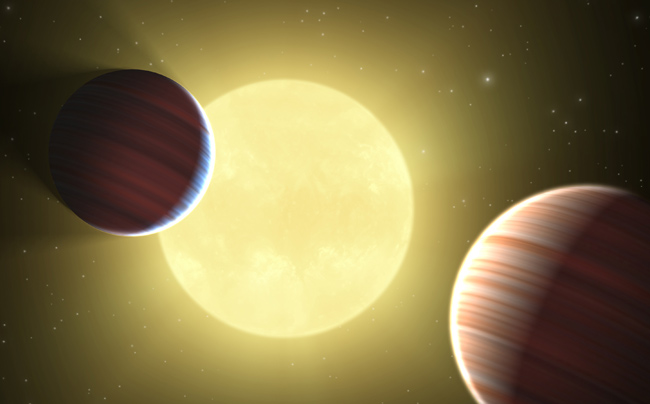
A newfound alien solar system with planets the size of Saturn circling close to their star is helping astronomers learn how some giant worlds snuggle up to their stellar parents like moths to a flame.

NASA's Kepler space observatory recently confirmed the presence of the two Saturn-sized planets that orbit a star about 2,300 light-years away from Earth. A third, much smaller planet may also orbit the star, circling so close that one year on the alien world would last just 1.6 Earth days.

While the discovery of the Kepler-9 planetary system is a major find, it is also a starting point for astronomers to learn how the planet arrangement formed in the first place. [Gallery - Strangest Alien Planets]

Scientists think these planets originated much farther from their parent star and gradually migrated inward over time. All three objects could fit inside the orbit of Mercury today.

"It's safe to say that they did migrate because they ended up in this very special set of orbits," said Alycia Weinberger, an astronomer in the department of terrestrial magnetism at the Carnegie Institution of Washington in Washington, D.C., when the planets were announced in late August."

"The likely candidate for how that migration happened is interaction between these planets and the original disk of material – the gas out of which they formed. It will now take some work to try to figure out exactly how that was likely to happen in this system," Weinberger said.

Timing planet paths

Understanding the process of planetary migration will help astronomers understand the initial conditions that led to the final configuration of the Kepler-9 system, and other planetary systems discovered in the future.

As a planetary system is being formed, "planets can change locations or migrate due to interactions with the raw materials with which they are built," Weinberger said.

A study led by Matthew Holman, associate director of the theoretical astrophysics division at the Harvard-Smithsonian Center for Astrophysics in Cambridge, Mass., determined that the two Saturn-sized planets, named Kepler-9b and Kepler-9c, have somewhat atypical orbits.

It takes Kepler-9b about 19.2 days to complete one orbit. The other Saturn-sized world, Kepler-9c, makes one orbit every 38.9 days, taking almost twice as long to complete the circuit.

"There is a near 2-to-1 orbital resonance, which means the planets have orbital periods in a 2-to-1 ratio," Holman told SPACE.com. "At this configuration, we can see that they strongly interact and we can see large variations in the orbits of the planets."

What planetary migration tells us

Studying how planetary migration occurs, and how much a planet has moved, can tell researchers a lot about the history of how such worlds and their local solar system formed.

Kepler-9b and 9c were found to have a lot of gravitational interaction, and they are located so close to their parent star that their orbits would fit inside the orbit of Mercury in our own solar system, said Holman.

The two planets most likely migrated to their observed locations, said Weinberger, because being so close to the star would have made it extremely difficult to develop and survive in the first place.

Observations combined with theoretical work will then be able to pinpoint how far apart the planets originated, how long it took them to form and how long their migration lasted.

"Kepler was designed and built to answer fundamental questions," Weinberger said. "We want to know what types of planetary systems there are; what is common amongst the various systems; whether there are any special conditions that result in Earth-like planets; whether the whole system of planet formation is robust and common."

Source: www.space.com


Friday, September 17, 2010

iOS 4.2 for Apple iPad released to developers


Apple has released a beta version of the iOS 4.2 software update to developers. A final version of the operating system is expected to be made available to all iPad users in November.

Steve Jobs unveiled details of the iOS 4.2 update at Apple’s music event earlier this month. He said that the update would bring some of the features previously only available on the iPhone and iPod touch to the popular iPad.

Developers have posted early reviews of some of the update’s new features, including a change to the functionality of the screen orientation lock which sees it become a mute switch. If the iPad user wishes to lock the orientation of the screen, they must now pull up the multitasking dock, swipe left, and select the lock button from the menu, just as users now do on the iPhone and iPod touch.

The iOS 4.2 update also brings folders to the iPad, allowing users to organise up to 20 similarly-themed apps in to single, named folders. iPhone and iPod touch users can only have 12 apps in a folder.

iPad users can also change the default font of the iPad’s Notes program, choosing between the default script, which makes notes look as they have been written using a marker pen, to the Helvetica and Chalkboard fonts.

However, one of the most significant changes is the introducing of AirPrint, which will initially allow iPad, iPhone and iPod touch users to wirelessly print to a compatible HP printer at the touch of a button.

"AirPrint is Apple's powerful new printing architecture that matches the simplicity of iOS,” said Phil Schiller, Apple’s senior vice president of product marketing. “There’s no set up, no configuration, no printer drivers and no software to download.”

Other new features of the iOS 4.2 software update include:

:: AirPlay: This new and improved version of Apple’s AirTunes wireless music-streaming feature enables iPad, iPhone or iPod touch users to stream content (such as photos, movies or music) directly from their device to an AirPlay-compatible receiver. Initially, this will be AirPort Express base stations for music streaming, and the new Apple TV for audio and video streaming. It is likely that Apple will license the AirPlay software to third-party manufacturers to build their own compatible solutions.

:: Safari: Tweaks to the iPad’s browser now make it easier to see how many pages a user has open. It also enables users to search for text on a page, and highlights all mentions within the web document.

:: Game Centre: Apple’s online gaming portal, Game Centre, is optimised for the iPad interface. A new Game Centre icon appears on the iPad’s desktop, while the Game Centre portal itself has been tweaked to look better on the iPad’s larger screen.

Apple has sold more than three million iPads since the touch-screen, tablet style computer first went on sale earlier this year.

source: www.telegraph.co.uk


Thursday, September 16, 2010

Moon's Face Reveals Extreme Cosmic Abuse


The moon's pimpled face is a testament to the serious beating it's received over the years from incoming space rocks, and a new study has found just how severe that lunar smackdown has been.

Scientists have compiled the first comprehensive catalog of large craters on the moon to document its cosmic abuse. They've also made a detailed study of minerals on the moon and identified areas of unusual silica-rich composition, in a pair of related studies.

The new findings are detailed in threepapers in the Sept. 16 issue of the journal Science.

Mapping the holes

In a second study, scientists built a new lunar crater map with data from the Lunar Orbiter Laser Altimeter instrument on NASA's Lunar Reconnaissance Orbiter,which includes 5,185 craters that are 12 miles (20 km) in diameter or larger.

The database provides a window on the past, revealing which parts of the moon are most pockmarked, and therefore represent older surfaces, and which areas have been covered over with fresh material by volcanism relatively recently. The researchers discovered that the moon's oldest regions are the southern near side and the north-central far side.

One feature, the South Pole-Aitken basin, appears to be the oldest basin on the moon. As such, it could offer unique clues about the moon's history, and the story of the early solar system in general.

The findings "are telling us something about the infancy of the solar system," said the study's leader James W. Head III, a planetary geologist at Brown University, in a statement. "It is clear we can find out and learn so much more from future missions, robotic or otherwise. There is so much to do."

Rare moon minerals

Researchersused the Diviner Lunar Radiometer Experiment, also on the Lunar Reconnaissance Orbiter, to measure the infrared light coming from the moon in several frequencies. Long-wavelength infrared light is heat energy, and it can give researchers information about some of the mineral content of the lunar surface not available from visual or other-wavelength observations.

In particular, the scientists looked for areas rich in silica (made of the chemical compound silicon dioxide), a type of rock that includes quartz and other formations. This compound is relatively rare on the moon, and requires a particular volcanic process for creation.

The team found five spots on the moon rich in silica, showing that this mineral does exist on the moon, but is indeed rare.

A third team of researchers, led by Timothy D. Glotch of New York's Stony Brook University, honed in on some of these spots and found that the silica on the moon is likely quartz, silicon-rich glass or alkali feldspar.

"The silica-rich materials have actually been proposed to be on the surface in these locations, but we have never sent an instrument that could detect them before," Greenhagen told SPACE.com. "It's important to know the silica-rich regions because they require a very specific type of crustal evolution."

"For the first time we're actually detecting how complex the lunar surface is," said planetary scientist Benjamin T. Greenhagen of NASA's Jet Propulsion Laboratory in Pasadena, Calif., leader of one of the mineralogy studies. "It's a bit of a paradigm shift." [See the new moon map]


Chandra Finds Evidence for Stellar Cannibalism


Evidence that a star has recently engulfed a companion star or a giant planet has been found using NASA's Chandra X-ray Observatory. The likely existence of such a "cannibal" star provides new insight into how stars and the planets around them may interact as they age.

The star in question, known as BP Piscium (BP Psc), appears to be a more evolved version of our Sun, but with a dusty and gaseous disk surrounding it. A pair of jets several light years long blasting out of the system in opposite directions has also been seen in optical data. While the disk and jets are characteristics of a very young star, several clues -- including the new results from Chandra -- suggest that BP Psc is not what it originally appeared to be.

Instead, astronomers have suggested that BP Psc is an old star in its so-called red giant phase. And, rather than being hallmarks of its youth, the disk and jets are, in fact, remnants of a recent and catastrophic interaction whereby a nearby star or giant planet was consumed by BP Psc.

When stars like the Sun begin to run of nuclear fuel, they expand and shed their outer layers. Our Sun, for example, is expected to swell so that it nearly reaches or possibly engulfs Earth, as it becomes a red giant star.

"It appears that BP Psc represents a star-eat-star Universe, or maybe a star-eat-planet one," said Joel Kastner of the Rochester Institute of Technology, who led the Chandra study. "Either way, it just shows it's not always friendly out there."

Several pieces of information have led astronomers to rethink how old BP Psc might be. First, BP Psc is not located near any star-forming cloud, and there are no other known young stars in its immediate vicinity. Secondly, in common with most elderly stars, its atmosphere contains only a small amount of lithium. Thirdly, its surface gravity appears to be too weak for a young star and instead matches up with one of an old red giant.

Chandra adds to this story. Young, low-mass stars are brighter than most other stars in X-rays, and so X-ray observations can be used as a sign of how old a star may be. Chandra does detect X-rays from BP Psc, but at a rate that is too low to be from a young star. Instead, the X-ray emission rate measured for BP Psc is consistent with that of rapidly rotating giant stars.

The spectrum of the X-ray emission -- that is how the amount of X-rays changes with wavelength -- is consistent with flares occurring on the surface of the star, or with interactions between the star and the disk surrounding it. The magnetic activity of the star itself might be generated by a dynamo caused by its rapid rotation. This rapid rotation can be caused by the engulfment process.

"It seems that BP Psc has been energized by its meal," said co-author Rodolfo (Rudy) Montez Jr., also from the Rochester Institute of Technology.

The star's surface is obscured throughout the visible and near-infrared bands, so the Chandra observation represents the first detection at any wavelength of BP Psc itself.

"BP Psc shows us that stars like our Sun may live quietly for billions of years," said co-author David Rodriguez from UCLA, "but when they go, they just might take a star or planet or two with them."

Although any close-in planets were presumably devastated when BP Psc turned into a giant star, a second round of planet formation might be occurring in the surrounding disk, hundreds of millions of years after the first round. A new paper using observations with the Spitzer Space Telescope has reported possible evidence for a giant planet in the disk surrounding BP Psc. This might be a newly formed planet or one that was part of the original planetary system.

"Exactly how stars might engulf other stars or planets is a hot topic in astrophysics today," said Kastner. "We have many important details that we still need to work out, so objects like BP Psc are really exciting to find."

These results appeared in The Astrophysical Journal Letters. Other co-authors on the study were Nicolas Grosso of the University of Strasbourg, Ben Zuckerman from UCLA, Marshall Perrin from the Space Telescope Science Institute, Thierry Forveille of the Grenoble Astrophysics Laboratory in France and James Graham from University of California, Berkeley.

NASA's Marshall Space Flight Center in Huntsville, Ala., manages the Chandra program for NASA's Science Mission Directorate in Washington. The Smithsonian Astrophysical Observatory controls Chandra's science and flight operations from Cambridge, Mass.

More information, including images and other multimedia, can be found at:


Five Things About NASA's Mars Curiosity Rover


Mars Science Laboratory, aka Curiosity, is part of NASA's Mars Exploration Program, a long-term program of robotic exploration of the Red Planet. The mission is scheduled to launch from Cape Canaveral, Fla., in late 2011, and arrive at an intriguing region of Mars in August 2012. The goal of Curiosity, a rolling laboratory, is to assess whether Mars ever had an environment capable of supporting microbial life and conditions favorable for preserving clues about life, if it existed. This will help us better understand whether life could have existed on the Red Planet and, if so, where we might look for it in the future.

1. How Big Is It?: The Mini Cooper-sized rover is much bigger than its rover predecessors, Spirit, Opportunity and Pathfinder. Curiosity is twice as long (about 2.8 meters, or 9 feet) and four times as heavy as Spirit and Opportunity, which landed in 2004. Pathfinder, about the size of a microwave oven, landed in 1997.

2. Landing--Where and How: In November 2008, possible landing sites were narrowed to four finalists, all linked to ancient wet conditions. NASA will select a site believed to be among the most likely places to hold a geological record of a favorable environment for life. The site must also meet safe-landing criteria. The landing system is similar to a sky crane heavy-lift helicopter. After a parachute slows the rover's descent toward Mars, a rocket-powered backpack will lower the rover on a tether during the final moments before landing. This method allows landing a very large, heavy rover on Mars (instead of the airbag landing systems of previous Mars rovers). Other innovations enable a landing within a smaller target area than previous Mars missions.

3. Toolkit: Curiosity will use 10 science instruments to examine rocks, soil and the atmosphere. A laser will vaporize patches of rock from a distance, and another instrument will search for organic compounds. Other instruments include mast-mounted cameras to study targets from a distance, arm-mounted instruments to study targets they touch, and deck-mounted analytical instruments to determine the composition of rock and soil samples acquired with a powdering drill and a scoop.

4. Big Wheels: Each of Curiosity's six wheels has an independent drive motor. The two front and two rear wheels also have individual steering motors. This steering allows the rover to make 360-degree turns in-place on the Mars surface. The wheels' diameter is double the wheel diameter on Spirit and Opportunity, which will help Curiosity roll over obstacles up to 75 centimeters (30 inches) high.

5. Rover Power: A nuclear battery will enable Curiosity to operate year-round and farther from the equator than would be possible with only solar power.


Information And Technology Copyright © 2010 IT is Designed by hantu-facebook