Sunday, April 24, 2011

Mac vs. PC: The stereotypes may be true


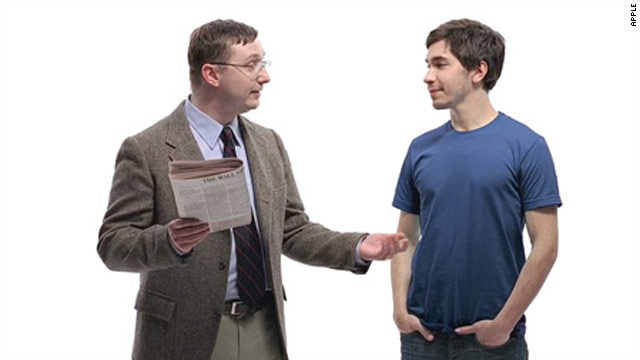
Remember those Apple ads that cast the Mac as a 20-something, self-satisfied hipster while the PC was portrayed by an older, square-looking guy in a brown suit?
Well, those characterizations, unfair as they may be, appear to have some truth to them.
An unscientific survey by Hunch, a site that makes recommendations based on detailed user preferences, found that Mac users tend to be younger, more liberal, more fashion-conscious and more likely to live in cities than people who prefer PCs.

Of the 388,000 Hunch users who responded to a question about computer loyalty, 52% identified themselves as PC people as opposed to 25% who said they are Mac devotees. Hunch then cross-referenced those responses with answers to other questions to draw cultural distinctions between the rival Mac and PC camps.
The results suggest Mac users can be seen, depending on your perspective, as bolder and more creative -- or elitist and more pretentious.

The report found that 67% of Mac users have a college or advanced degree, as opposed to 54% of PC users. Mac loyalists are 80% more likely than PC users to be vegetarians, and, unlike PC fans, would rather ride a Vespa scooter than a Harley.

PC users' tastes trend towards casual clothes, tunafish sandwiches, white wine, Hollywood movies, USA Today and Pepsi. Mac users prefer designer or vintage duds, hummus, red wine, indie films, The New York Times and (we're not making this up) San Pellegrino Limonata.

Mac users also are more likely to describe themselves as computer-savvy and "early adopters." PC users tend to describe themselves as better at math and less likely to throw frequent parties.
"I fit the typical Mac user on every count. Guess I'm not as unique as I thought. Depressing," wrote one commenter on Hunch's blog.

Since Hunch's first survey of Mac vs. PC users in November 2009, Apple has ridden the success of such high-profile products as the iPad and iPhone 4 to become the world's most highly valued tech company. Despite that hot streak, Hunch found that slightly more people in its new report -- 52%, up from 50% a year and a half ago -- now identify themselves as PC users.


Sunday, September 26, 2010

RIM and Samsung should avoid head-on Apple clash


A year ago, industry insiders debated whether a market existed for a device to bridge laptops and smartphones. Now, Samsung Electronics (005930.KS) and Research In Motion (RIM.TO) will be the latest to respond to Apple's gadget.

The iPad attracts many buyers with its sleek interface and i-Tunes music, video and software applications. Business people also use it as a portable display for presentations.

Ahead of BlackBerry maker RIM's expected unveiling of a tablet computer next week, analysts say RIM and its rivals will not succeed unless they offer lower prices or address a segment Apple has overlooked.

"We've yet to hear a convincing story about what the potential is beyond Apple," said CCS Insight analyst John Jackson. "The next successful tablet story will be one that doesn't try to take on Apple directly."

RIM plans to debut the BlackPad at a developers' conference starting Monday, according to a Wall Street Journal report. The device is expected to have a 7-inch touchscreen, which would be smaller than the iPad, and at least one camera.

It is expected to connect to the Internet via short-range Wi-Fi networks found in homes, offices and cafes. Outside Wi-Fi, the only way to connect BlackPad will be to tether it to a BlackBerry phone, according to the report.

It could appeal to cost-conscious customers reluctant to pay additional cellular service fees on top of their phone's data service charge. IPad users pay separate cellular service fees from $15 a month upward.

Several analysts said the lack of a direct cellular link would limit sales for RIM, which had 50 million BlackBerry users by the end of August.

The lack of a cellular service fee may also leave mobile network operators, RIM's main distributors today, without much incentive to promote the device.

"I have my doubts as to whether their tablet will succeed," said Morgan Stanley analyst Ehud Gelblum.

COURTING CONSUMERS

RIM has been successfully courting consumers with new BlackBerrys in recent years. But since businesses are key customers, RIM's best chance may be a tablet specifically for them, said Carmi Levy, an independent technology analyst.

"What I believe RIM is trying to achieve with the BlackPad is not to release a be-all end-all consumer product, but to release a very compelling enterprise product that also has crossover appeal to consumers," said Levy.

Aside from Apple and Samsung, RIM will also compete with rivals such as Dell Inc (DELL.O), which has developed at least two tablets, and Hewlett-Packard (HPQ.N) and Motorola Inc (MOT.N), which plan tablets for 2011.

Some analysts say Samsung's Galaxy Tab is the most credible iPad rival, given it is not only smaller but -- perhaps more importantly -- the Korean conglomerate has forged partnerships with the top four U.S. mobile carriers and with media companies which are providing programing for its Media Hub service.

Nick DiCarlo, Samsung's U.S. director of product planning, listed three features that trump iPad: cameras for two-way video chat, support for Adobe Systems Inc (ADBE.O) Flash software and a compact size that fits in a suit pocket.

"No one of them by themselves would be enough, but all together, they're special," DiCarlo said in an interview.

DiCarlo also pointed to Samsung's media partners: NBC Universal and Viacom's (VIAb.N) Paramount and MTV, which brings hit shows like Jersey Shore. Time Warner Inc (TWX.N) and CBS Corp (CBS.N) are also in talks with Samsung to provide video for Galaxy Tab, according to two sources familiar with the matter.

However, iPad is backed by Apple's long-established iTunes digital media store -- which has the industry's largest library of 250,000 mobile applications. Samsung is depending on Google Inc's (GOOG.O) far smaller Android software store.

Thus, pricing of the Galaxy Tab and its connection services will be crucial, according to analysts who say any iPad rivals need to sharply undercut Apple to entice consumers.

Samsung has not released U.S. pricing for the device as carriers will set the price. But if its suggested price in other markets is any guide, it looks like the device will be more expensive than iPad unless carriers subsidize it.

The company had said the suggested retail price in Finland will be 949 euros ($1,278), well above the iPad's $629 tag.

U.S. operators typically subsidize phones for customers who commit to long-term contracts. When carriers get exclusive rights to sell a device, they promote it more heavily.

But since the Tab will not be exclusive, Current Analysis analyst Avi Greengart said no carrier will "spend outsized marketing budgets promoting Galaxy Tab because they're not likely to get outsized benefits."

DiCarlo said marketing will be a collaborative effort with carriers. And Dan Hesse, head of No 4 operator Sprint Nextel (S.N), indicated that Tab would be important to Sprint.

Hesse said it would be "very affordable" as he pulled out the gadget at an investor conference this week to show off how he easily he could fit it in his suit pocket.

Some say the real battle begins next year when Apple rivals have more time to respond to iPad, which went on sale in April. But Morgan Stanley's Gelblum said the consumer electronics market may not give somebody like RIM a second chance.

"They have to hit it in the beginning. They don't have enough goodwill out there to come out with half a product and then improve it over time. The market is moving too fast."

Source: www.reuters.com


Thursday, September 23, 2010

Bilingual NASA Chat: I'm a NASA Pilot (Yo Soy el Piloto por NASA)


Herman Posada sits at the controls and flies his airplane. But he's not in the airplane! He's at a ground station miles away, using a joystick and video monitors to control the vehicle.

Herman is a NASA research pilot who flies unmanned aerial vehicles. These remotely piloted, full-scale aircraft are used more and more for research into advanced aeronautics systems and for capturing images and data in dangerous conditions such as wildfires or hurricanes.

On Thursday, September 23, you can ask Herman questions in both English and Spanish about what it's like to fly these unique, full-scale aircraft.

NASA's Ikhana, an unmanned Predator B modified for non-military missions, carries instruments for environmental Earth science studies and is used for advanced aircraft systems research and technology development. The Global Hawk unmanned aircraft has been very busy this hurricane season, flown by Herman and another pilot into and above hurricanes to collect data.

How did Herman get interested in flying? What's different about flying unmanned aircraft compared to regular aircraft?

Join Herman on Thursday, September 23, at 3:00 p.m. EDT to ask your questions in both English and Spanish about his experiences as a NASA research pilot for unmanned aerial vehicles. To join the chat, simply come back to this page on September 23. The chat window will open at the bottom of this page starting at 2:30 p.m. EDT. You can log in and be ready to ask questions at 3:00 p.m.

See you in chat!

More About Herman Posada

Herman Posada is a research pilot in the Flight Crew Branch at NASA's Dryden Flight Research Center, Edwards, Calif. He began his aviation career as a line mechanic and general aviation pilot. He flew a fixed-wing aircraft for Los Angeles traffic and aerial news organizations and piloted a number of other unmanned aerial vehicles, which took him on travel worldwide. He has more than ten years experience flying the Predator A MQ-1 and Predator B MQ-9 aircraft, including 300 hours as an instructor pilot. While Herman's parents are from Colombia, he was born and raised in Los Angeles, Calif.
Source:


Facebook working on creating two smartphone devices: report


The smartphones would carry the popular social networking website's services and were set to be unveiled in Europe in the first half of 2011 and the United States in the second half of the year, the report said.

Privately held Facebook said previously that it was not building its own phone. Jaime Schopflin, a spokesman for Facebook, said the company's current projects included "deeper integrations with some manufacturers."

AT&T, the No. 2 U.S. mobile provider, is still thinking about whether it should be the network carrier for the Facebook smartphone and has not yet made a deal, Bloomberg said.

None of the companies could not immediately be reached for comment by Reuters outside of regular U.S. business hours.

Facebook declined to comment to Bloomberg on plans for specific phones. The company, however, told the agency that it continues to work with INQ Mobile, which has previously sold phones with Facebook features, along with other companies.

INQ Mobile, which is based in London and is backed by Hong Kong telecom firm Hutchison Whampoa Ltd, declined to comment to Bloomberg. (Reporting by Sakthi Prasad in Bangalore

Source: www.reuters.com


Tuesday, September 21, 2010

World's Smallest Stop-Motion Animation Filmed


I love this little (literally) stop-motion animation. Not only did "Dot" break the Guinness World Record for Smallest stop-motion animation character in a film, it was shot using life-saving technology.

First about the film, which you can watch below. It features Dot, a girl who just 9 millimeters tall. She wakes up in a world that seems to be unraveling. Fleeing an encroaching wave of loose threads, Dot runs across coins, pins, nuts and bolts and jumps on a bumblebee to fly away. Finally she saves herself by knitting the threads into a sleeping bag.

Now about the life-saving technology. The animation was filed using a Nokia N8 smart phone equipped with a CellScope, a diagnostic-quality microscope that was invented by Daniel Fletcher at the University of California, Berkeley. The CellScope allows a doctor working anywhere there is a phone service to capture and transmit images of blood samples anywhere in the world. The technology could help diagnose disease in developing countries where medical doctors and labs are few and far between.

Another bit of technology was used that, although not life-saving, is an interesting application. It's 3-D printing. It was used to create various molds of Dot posed in different positions. Normally such an animation would rely on clay manipulated manually to adjust the character's body positions. But Dot was too small for this and so her body positions were adjusted using molds of her in various positions.

Source:


Satellites TELKOM-2 Indonesia


TELKOM-2 is a C-band geosynchronous communications satellite built by Orbital for Indonesia's state-owned telecommunications company, PT Telekomunikasi Indonesia Tbk (PT Telkom). TELKOM-2 was successfully launched November 16, 2005, and positioned in geosynchronous orbit, 22,300 miles above the Earth, at 118 degrees East longitude.

Based on Orbital's highly successful and flight-proven STAR-2™ spacecraft platform, TELKOM-2 features state-of-the-art communications satellite technology, and 24 C-band transponders. The new spacecraft will replace PT Telkom's on-orbit Palapa-B4 satellite, improve communications coverage across Indonesia, and allow PT Telkom to expand its coverage area into southeast Asia and the Indian subcontinent.

In addition to providing the spacecraft bus and payload, Orbital is supplementing Telkom's existing ground segment through the addition of a state-of-the-art ground station including all hardware and software. Orbital is also providing extensive mission operations support.
Performance:
Repeater: two groups of 15-for-12 linearized traveling wave tube assemblies (TWTAs)
Transponder Power: 39 watts RF
Stabilization: 3-axis, zero momentum
Launch mass: 1,930 kg (4,255 lbs)
Mission life: 15 years (>15 years of fuel)
Status:
TELKOM-2 was successfully launched on November 16, 2005.


Coming to Hospitals Near You: Self-Navigating Robots


You've probably watched enough television shows about hospitals to know that they're busy places, where the right tools need to be in the right place at just the right time in order to help save lives. With hundreds of nurses, doctors and orderlies racing around, mistakes happen.

But although humans are prone to mistake-making, robots aren't. Plus, they work for almost nothing once you get them running. At least, that's the thinking behind hospitals that are starting to use autonomous robots to transport goods throughout the building.

In the era of relentless cost-cutting, hospital executives would much rather have cost-efficient robots roaming around the hospital with secure carts of linens, lab specimens and meals, than expensive staff.

Pittsburgh, PA-based Aethon has such a robot, the TUG (above), which navigates a hospital using a digital map of the building. Each TUG robot is equipped with a matrix of light whiskers to detect people and obstacles. Those "light whiskers" are made up of sonar, infrared and laser technologies for sensing capabilities in any situation.

But there's only so much I can convey about this robot with words, so this video is worth a view. It's the TUG robot in action at the Veterans Administration hospital in West Roxbury, just outside Boston.

Weighing in at 55 pounds, it's powered by a couple of independent 12-volt DC motors that recharge automatically when it's not in use. When it's fully charged, it's supposed to be in continuous operation for ten hours before needing another charge.

Robots of all sorts are getting better at communicating with each other, and TUG robots are no different. They can "talk" with each other in the hallways to get information about the most efficient way to get to their destinations.

TUG robots have at least one more advantage to humans, albeit slightly hidden: no one is going to create yet another TV show in a hospital about the drama between hospital robots.

Source: http://dsc.discovery.com


Spacewalking May Cost Astronauts Their Fingernails


Here’s a scene you may have missed: Astronauts seal themselves into pressurized spacesuits and leave their ship to make repairs outside. When they get back, one guy peels off his glove liner, looks down and sees that his fingernail has come off too.

Turns out, that’s not fiction. “It’s probably the biggest nuisance,” says Deva Newman, an MIT professor who conducted a statistical analysis of injuries reported during spacewalks. “It’s not a show-stopper, but it is the most prevalent thing.”

The problem is particularly pressing for astronauts with wide fingers, Newman and colleagues found, a result that questions conventional wisdom that nail trauma results from astronauts' fingers repeatedly contacting hard inner surfaces of their balloon-like gloves.

Some of the damage may be due to the gloves impeding blood flow at the joints where astronauts' fingers attach to the palms of the hands.

“The damage is cumulative. The astronauts are wearing these gloves hundreds if not thousands of hours for training,” Newman says.

The glove “looks soft, and it is until it's pressurized,” veteran spacewalker Stephen Robinson said in a NASA interview. “In the vacuum of space, it's pressurized and it's actually like a little balloon and it's quite stiff … so, every time you want to move your hand, you have to overcome the stiffness of this balloon glove. You do lots of hand exercises (to prepare) and when you come in after a spacewalk, your hands are sore.”

Newman’s group at MIT is looking at alternative glove designs, as are other research organizations and private firms, including a company set up by former aerospace engineer Peter Homer who won NASA prize money for his efforts.

Newman research will be published next month in the journal Aviation, Space and Environmental Medicine.

(Image: A prototype spacesuit glove undergoes testing during a NASA competition in April. Credit: NASA)


Source: http://dsc.discovery.com


Sunday, September 19, 2010

Clever Cars to Mean Safer Driving


Cars could soon be ringing the emergency services themselves if they are involved in a crash.
Sensors embedded in future vehicles could also let emergency services work out the severity of the crash and how many people were involved.
The predictions came at a symposium considering the changes ushered in by the spread of small, smart processors.

The growing number of on-board computers could also spell big changes for the way people drive.

"The car is probably going to be the most compute-intensive possession that we will have," said Steve Wainwright, European manager at Freescale Semiconductor which makes many of the chips inside car control systems.

Mr Wainwright said average cars have 25-30 electronic control units onboard already and high-end cars probably carry up to 80. These tiny computers are in charge of many car systems such as stability control, power distribution, safety and many others.

Increasingly, said Mr Wainwright, they are helping to augment a person's driving skill and that trend would only continue as technologies such as collision detection systems and radar become more commonplace.

"All of us who feel we are better drivers now than we were 10 years ago, that's probably because we are getting more help then we realise," he said at the Future World Sympoisum, a conference organised by the UK's National Microelectronics Institute.

Quick response

Paul Burnley, an analyst from automotive market research firm SBD, said cars in the future would be among the first to react after a crash. They might send data about their location and the number of occupants in a car to get the emergency services responding much more quickly.

"More advanced systems will be capable of sending data from distributed sensors in the car to the emergency services," he said.

"Perhaps letting them analyse this and build a profile of the crash and evaluate the risk of serious injury to the occupants."

Clever in-car systems would be essential as the world moves from petrol-driven cars to hybrid and electric vehicles, he said.

"The 'hop in the car and drive where you want' mentality is not one we can carry forward to electric vehicles," he said. "Fears about range anxiety and charging infrastructure are starting to dominate discussions about such vehicles."

Only with sensors that can accurately determine the distance a car can travel given the charge in its batteries and know the location of the nearest charging station, will the move to electric vehicles be more palatable, he said.

Safer roads

Mr Wainwright from Freescale believed that the growing unification of cars and computers had the potential to make driving safer and greener.

Already, he said, the US has set aside radio spectrum for car-to-car communication systems suggesting that the future will see more inter-vehicular chatter about road conditions. Europe is also considering which radio frequency to use for this communication.

The opening up of this communications channel could pave the way for so-called "platooning" of cars on motorways in which convoys of vehicles are electronically linked and travel together.

National Integrated Transport Systems (ITS) that have the ability to gather cars into platoons, dictate routes and keep high density traffic in cities moving much faster were starting to emerge, said Mr Wainwright.

Research suggests that increasing the average speed of vehicles in cities from 20km/h to 30km/h could save about 1.9 billion hours globally, he said.

"If you think about what you can do with smart routing and dynamic routing if you have a good ITS, it absolutely makes anything that you can do on engine management completely pale into insignificance," he said, "The benefits you can get there are enormous."

However, he said, the hurdle to getting such systems up and working had little to do with technology.

"The key issues are clearly not technology but social," he said, "It's the freedom of the open road versus what would it take to have your route pre-determined for you, or some level of control taken away."

ITS could make driving much safer and cut the number of deaths on the road from the current total of 50 per week in the UK, said Mr Wainwright, but only if there was the political will to bring the system in.

"This is a liberties question," he said.

"Do you want to be able to have the right to drive completely irresponsibly, potentially kill people and waste resource?" he asked. "Well, it seems we do. We seem to think that is more important than killing people."
More on Thi

Source: www.bbc.co.uk


MIT unveils swimming, oil-cleaning robots


Here's a new way of looking at oil spill clean-up: Forget the big ships, massive work crews and hefty price tags.

Instead, just deploy an army of autonomous, oil-scrubbing robots. They can find the oil on their own. And when they reach the site of an oil spill, they talk to their robot friends to figure out the best way to get the whole thing mopped up.

That's the vision the Massachusetts Institute of Technology put forward on Wednesday as the school announced the development of a prototypical robot called Seaswarm. The $20,000 robots will be unveiled officially to the public on Saturday at an event in Venice, Italy, and will be ready to deal with oil spills in about a year, said Assaf Biderman, who oversaw MIT's research team on the project.

The Seaswarm robots, which were developed by a team from MIT's SENSEable City Lab, look like a treadmill conveyor belt that's been attached to an ice cooler. The conveyor belt piece of the system floats on the surface of the ocean. As it turns, the belt propels the robot forward and lifts oil off the water with the help of a nanomaterial that's engineered to attract oil and repel water.

"You can imagine it like a carpet rolling on the surface of the water," said Biderman, who also is associate director of the SENSEable City Lab.

The material on the robot's conveyer belt, which MIT calls a "paper towel for oil spills," can absorb up to 20 times its weight in oil.

Once it has absorbed the crude from the surface of the ocean, the robot can either burn off the oil on the spot, using a heater on the "ice cooler" part of its body, or it can bag the oil and leave it on the surface of the water for a later pick-up, Biderman said. That oil could be reused or recycled.

The robots are designed to work in a swarm, he said, meaning thousands could be deployed on the same spill at once. They coordinate with each other by using GPS location data. That lets them plot out the most efficient way to tackle a clean-up project.

Biderman said the Seaswarm robots are relatively cheap, quick and effective at cleaning up oil spills.

Had they been deployed on the Deepwater Horizon oil disaster, he said, the Seaswarm robots would have cleaned up the oil in two months at a cost of $100 million to $200 million, far less than the actual clean-up bill.

The Seaswarm robots operate on solar energy and require only 100 watts of power, or about that of a bright light bulb. They could stay at sea for months, Biderman said, and could operate around the clock.

The conveyor belts on the robots also are engineered in a way that they hug the water to prevent them from flipping over.

"Because it adheres to the surface of the water, it cannot capsize," he said, "So it can withstand quite severe weather. Imagine this like a leaf that lands on the surface of the water and moves with the waves and the currents and cannot be flipped over."

Traditional oil skimmers are attached to large boats. They must be operated by people, which increases their cost and they are hampered by severe weather.

About 800 skimming boats were deployed in response to the Deepwater Horizon oil disaster, which began in April and led to nearly 5 million barrels of oil being released into the ocean, according to government estimates. By comparison, 5,000 to 10,000 of MIT's autonomous robots would have been needed to respond to the spill, Biderman said.

MIT will continue research on the robots for about a year, he said, at which time the robot technology would be ready for commercial production and possibly a buyer.

Other groups are developing oil-spill cleanup technology, too.

Case Western Reserve University has developed another nanotechnology "sponge" material that could be used in response to such disasters.

And a company called Extreme Spill Technology says on its website that it has developed a traditional, boat-based skimming technology that works much more quickly and in rougher waters than the traditional skimmers.

Biderman said MIT's oil-sopping robot would be most effective in situations like the recent oil disaster, where oil is spread out.

"Ideally, when spillage happens, the best thing to do is to contain it right where the spillage occurs," he said. "But quite often the oil goes out of containment, and this is where this technology would be most effective."

But the robots were actually designed with smaller, localized clean-ups in mind, he said.

"We're hoping that spillage like what we've seen with Deepwater Horizon will not occur again, but oil leakage constantly happens and that's really what motivated us," he said. "When you drill offshore, you always have leakage. And you can imagine a team of robots waiting around the corner for a spill."

Source: http://edition.cnn.com


Saturday, September 18, 2010

Railway to the Sky? NASA Ponders New Launch System


Imagine this: A wedge-shaped aircraft attached to a supersonic jet engine is hurtling along an electrified track, carrying a pod or spacecraft destined for orbit.

Sound farfetched? It may not be.

A team of engineers from NASA's Kennedy Space Center in Florida and some of the agency's other field centers are looking into this and other novel launch systems based on cutting-edge technologies.

Scramjet sky launch pads

One early proposal calls for mounting the launching aircraft on scramjets, which are air-breathing jet engines driven by supersonic combustion.

The aircraft would fly up to Mach 10, using the scramjets and wings to lift it to the upper reaches of the atmosphere, and then a small payload canister or space capsule similar to a rocket's second stage would fire off the back of the aircraft and into orbit.

After the high-altitude launch, the mother aircraft would return to land on the runway where its trip began.

The launch system would require some advancements of existing technologies, but it wouldn't need any brand-new technologies to work, said Stan Starr, branch chief of the Applied Physics Laboratory at Kennedy Space Center.

"All of these are technology components that have already been developed or studied," Starr said in a statement. "We're just proposing to mature these technologies to a useful level, well past the level they've already been taken."

Riding rails to space

The scramjet launcher project could form the foundation of a future Advanced Space Launch System, with elements spread across different NASA centers to make it work, agency officials said.

At the Kennedy Space Center, a 2-mile (3.2-kilometer) test-launch track could be installed between NASA's huge Vehicle Assembly Building – where shuttles are assembled for launch — and Launch Pad 39A, from where orbiters blast off.

But there are some challenges. To launch on an electrified track, for instance, the track would have to withstand at least 10 times the speeds commonly seen on tracks used for roller coasters, NASA scientists said. Roller coasters typically run about 60 mph (100 kph), they added.

NASA scientists also are looking into other methods of powering a track-launched vehicle.

A study into a rail launcher that uses gas propulsion is under way, with Starr's team applying for more funding through NASA's innovative-technology program to pursue it.

Engineers with NASA's Marshall Space Flight Center in Huntsville, Ala., have tested a prototype track-based system that uses magnetic levitation to accelerate vehicles to launch speeds.

As for aircraft launching from a rail, there are some real-world tests for designers to draw on. NASA's X-43A, or Hyper-X, program and the U.S. Air Force's recent X-51 scramjet tests have shown that scramjets can achieve remarkable speeds.

In late May, the Air Force's X-51A Waverider scramjet test vehicle set a world record for the longest hypersonic flight. The vehicle flew faster than Mach 5 for more than three minutes, compared with the previous record of 12 seconds by NASA's X-43A craft in 2004.

Commercial scramjet launches ahead?

Scramjet vehicles could be used as a basis for a commercial launch program if a company decided to take advantage of the basic research NASA performed along the way, Starr said.

Starr and his engineering team propose a 10-year plan that would begin with launching a drone similar to those used in the ongoing Air Force tests. More-advanced models would then follow, with the goal of developing a vehicle that can launch a small satellite into orbit.

The Advanced Space Launch System is not geared to replace NASA's retiring space shuttle fleet, or any other manned spacecraft program, Starr said. But if the early unmanned launches were successful, the system could eventually be adapted to carry astronauts, he said.

Source: www.space.com
<!--37e6b3c3a86545deb801f1ac0e88513b-->


My Generation iPad app syncs with TV


(CNN) -- Don't have a friend who will watch TV with you?

Now you can turn to your iPad for company.

A new app for Apple's tablet computer will listen to the ABC television series "My Generation" with you, and serve up content to augment the experience.

Using the iPad's built-in microphone, the free "My Generation Sync" app literally syncs up with the TV show so it can give you information about what's happening at that very moment on the television.

The app would let viewers "take polls and quizzes" and "get behind the scenes" info as the show progresses, according to a description in the iTunes App Store. The app also lets viewers connect with social networks.

It launched Thursday, according to the site.

The show-syncing program comes as TV viewers -- like everyone else -- tend to multitask while watching their favorite shows. Online social networks such as GetGlue and Miso let viewers "check in" to certain programs, alerting their friends to the things they're watching and reading at any given time. Others have sought to bring social network chatter into TV programming, or TV programming into social networks such as Facebook.

In a recent interview with The New Yorker, Facebook founder Mark Zuckerberg said he thinks media-viewing will only get more social.

"Zuckerberg imagines Facebook as, eventually, a layer underneath almost every electronic device. You'll turn on your TV, and you'll see that fourteen of your Facebook friends are watching 'Entourage,' and that your parents taped '60 Minutes' for you," Jose Antonio Vargas writes in that magazine.

An executive at ABC also told The Hollywood Reporter that the new "My Generation Sync" app plays on the trend of people fiddling with other electronic devices while sitting in front of the TV.

"The big thing that's changed to make a go at this again is more and more people are multitasking in the living room environment," Albert Cheng told that publication.

"This was another opportunity to take a crack at this again."

Source: http://edition.cnn.com


Food for Mars: A Daunting Challenge


Most people find the palatability of in-flight entrees an oxymoron. But even frequent fliers seldom encounter more than a few such meals per week. Astronauts, in contrast, may have to survive months in orbit dining on a really limited menu of processed foods and reconstituted beverages served from oh-so-glamorous plastic pouches. Luckily, even the International Space Station can restock its pantry several times a year because these foods are relatively perishable. Which explains the problem NASA faces in planning for really long missions -- like a trip to Mars.

Astronaut foods may appear indestructible, but many crew favorites don't retain their nutrition or palatability for even a year, notes Michele Perchonok.

She should know. Perchonok manages not only NASA's advanced food technology program, but also the development and preparation of foods for Shuttle astronauts. At the Institute of Food Technology annual meeting, on July 20, she described NASA's limited larder.

Foods destined for Space Shuttle missions must have a shelf life of a year, and 18 months if they'll be deployed on the International Space Station. Of the roughly 65 foods currently available for stocking spacecraft and deemed really palatable by NASA taste panels, 10 will lose their appeal within a year -- turning off-color, mushy or tasteless, she reported. By the end of five years, Perchonok says, "we're down to seven items."

Moreover, she adds, "studies have shown that if the acceptability or the sensory properties degrade, so does the [food's] nutrition." Indeed, after one year, space food exhibits notable losses of vitamin A, folic acid (an important B vitamin) and thiamine (another B vitamin that plays a role in the body's use of carbs and certain building blocks of proteins). And nutrient losses don't end there, Perchonok says. "Basically, after one year, we are out of vitamin C."

Sure, NASA could supply astronauts with multi-vitamin pills. But that's no panacea, Perchonok observes, since preliminary studies by NASA have shown that the potency of vitamins diminishes faster in pills than it does in foods.

Clearly, she says, these food-nutrient losses are "pretty serious." So if NASA wants to be able to stock a spacecraft for Mars travel, "we've got a problem."

Using current propulsion systems, the space agency has to plan on it taking between 6 and 8 months to travel each way to Mars, Perchonok explains. Since Mars and Earth come close to each other only once every other year, crews "will have to stay on the surface for 18 months" before returning home, she adds.

Because glitches may arise or crews may be asked to help stock a Martian pantry for followup visitors from Earth, NASA's goal is the development of foods that will remain both safe and appetizing for at least five years.

Canned goods have a good shelf life, but can't be heated in microwaves -- and are considerably heavier than the pouches that astronaut food is dispensed in today. And weight is a big issue. It constitutes about 15 percent of the payload of food, which is expected to weigh 9,660 kilograms (10.6 U.S. tons) for a crew of 6 heading out to Mars.

To keep the weight down, foods are eaten in their packaging. And today's foil-lined pouches tend to work well when conventionally heat sterilized -- but can delaminate when their contents are subjected to "pressure assisted" thermal sterilization, a new technique being developed by C. Patrick Dunne of the Army's Natick, Mass.-based Soldier R&D Center and his colleagues. Dunne's consumers are military troops sent into the field with rations packaged as meals ready to eat, or MREs. (Dunne's innovative pressure-assisted sterilization helped him win selection as an IFT research fellow, last year.)

MREs must have a shelf life of three years at 26 °C, Dunne reported at the IFT meeting, last week. And though the experimental pressure-assisted sterilization system he reported on is slow (able to sterilize just 10 MREs per half hour), he expects the technology eventually can be scaled up to a continuous processing of 50 pouches per minute.

The new technology's real benefit is taste, he noted. A salmon fillet in Alfredo sauce processed with the new pressure-assisted technology not only tastes yummy, he says, but also "looks like a salmon that was poached -- not like cat food."

Taste is a particularly pivotal issue for astronaut food: Crews need to eat every bite of what they open up. Crumbs from cookies or crackers can make a mess and eventually get into someone's eyes, Perchonok says. Wet foods that aren't completely gobbled up will eventually go bad and stink up a spacecraft. Which can become especially nasty since astronauts don't take out the trash every day but bring it back home with them or hold it for months until they can pack it into a craft that is destined to travel towards Earth's surface (but actually incinerate in the atmosphere).

Bottom line, Perchonok says: NASA needs new ideas for light-weight, very air-tight flexible food packaging that can seal in freshness and sterility for at least three years. Luckily, there should be ample time to find such alternatives since travel to Mars is still many years away, Perchonok says: "Probably 2035 at the earliest."


Aerospace Goliath Enters Private Spaceflight Arena


So with much aplomb, The Boeing Co., has decided to throw its Goliath-class reputation into a commercial space arena populated by startups, internet entrepreneurs and small firms working to pioneer the space frontier, with the goal of helping aspiring non-professional astronauts fulfill their dreams.

“One of our stated goals in our division is to become the Boeing commercial aircraft of human space commerce,” said Brewster Shaw, a three-time shuttle astronaut who now serves as a Boeing vice president and general manager.

"Very few people have made it to orbit, probably a little over 500 out of some six or seven billion people. That's one out of 60 million human beings have had the opportunity to experience viewing our world from orbit. That's not enough. We want to see many more have that opportunity,” Shaw told reporters during a conference call.

Boeing’s answer: a seven-person capsule it calls the CST-100 (CST stands for Crew Space Transportation) which the firm is developing to rival Space Exploration Technologies’ Dragon spaceship, among others. All the contenders are eying potentially lucrative contracts taxiing NASA and partner astronauts to the International Space Station, an idea that has sharply divided Congress.

The press conference was to announce Boeing’s marketing agreement with Space Adventures, a Virginia-based outfit that brokered junkets to the space station for seven business tycoons, including Microsoft co-founder Charles Simonyi, who enjoyed the experience so much he went twice.

"The marketplace,” says Space Adventures’ chief Eric Anderson, “has not been constrained by the number of people who wanted to go. It’s been constrained by access to orbit.”

In addition to flying to the space station, Boeing plans to use its capsules to reach other planned orbital outposts, including inflatable habitats being built by Las Vegas-based Bigelow Aerospace. Free-flying rides, similar to what Virgin Galactic is planning on a suborbital scale, are not in the cards at this time, John Elbon, Boeing’s manager for commercial crew transportation systems, tells me.

Elbon and Anderson say the price to ride on CST-100 “will be competitive” with Soyuz, which currently costs NASA $51 million per seat. The last private space flier to the station, Guy Laliberté, the founder of Cirque du Soleil, paid about $40 million a year ago.

NASA has yet to weigh in on how many non-staff personnel would be welcomed aboard the station and for how long. And despite Boeing’s altruism to make us all space-farers, the company has no plans to pursue its space taxi without more seed funds from the government.

“If we had to do this with Boeing investment only we wouldn’t be able to close the business case,” Elbon said.

NASA last year awarded Boeing a contract worth $18 million for work on CST-100, part of a $50 million investment in a range of commercial crew vehicles.

The agency also awarded two firms -- Space Exploration Technologies, or SpaceX, and Orbital Sciences Corp. -- contracts worth a combined $3.5 billion to develop and fly rockets and capsules to deliver cargo to the station after the shuttles are retired next year.


Friday, September 17, 2010

Snake Robots Could Disable Explosives


Snakes can creep and they can crawl, but they're not very good at defusing bombs or going on search-and-rescue missions. Snake robots, however, might be a different story.

In a project called the Robotic Tentacle Manipulator, engineers at the U.S. Army Research Laboratory are developing snake-like autonomous robots that can go into dangerous situations in place of live soldiers to aid in search and rescue missions and to inspect potential threats from Improvised Explosive Devices, or IEDs.

That type of explosive has been a major source of headaches for the military in Iraq and Afghanistan, which at times has been responsible for half of U.S. military deaths in the region. Instead of sending soldiers into harm's way to find and deactivate these explosives, snake robots would do the job.

These snake robots are equipped with electronic sensors, laser detection and ranging called LADAR, which renders 3-D images of object shapes and physical properties. Touch sensitive sensor allows the bot to feel, balance and rotate objects.

Such robots have several advantages over other kinds of robots because:

* They are scalable, meaning they can be built big or small.
* They can travel over rough terrain or climb stairs. One of the researchers, Derek Schererer, says in a press release, "Consider that snakes push off rocks or roots to propel their bodies. We are using this same concept in development."
* Several snakes in one area can work as a team to scan a room or manipulate an object.
* And they may be able to solve the persistent "opening a door" problem, which is exactly what it sounds like: robots can't open doors. But high levels of articulation in the snake robot could prove to be effective for grasping and rotating different types of door handles.


Autonomous robots being able to communicate with each other is a major area of research. I just wrote about how researchers are developing underwater robots that can communicate with each other to accomplish a single mission.

Source: http://news.discovery.com


iOS 4.2 for Apple iPad released to developers


Apple has released a beta version of the iOS 4.2 software update to developers. A final version of the operating system is expected to be made available to all iPad users in November.

Steve Jobs unveiled details of the iOS 4.2 update at Apple’s music event earlier this month. He said that the update would bring some of the features previously only available on the iPhone and iPod touch to the popular iPad.

Developers have posted early reviews of some of the update’s new features, including a change to the functionality of the screen orientation lock which sees it become a mute switch. If the iPad user wishes to lock the orientation of the screen, they must now pull up the multitasking dock, swipe left, and select the lock button from the menu, just as users now do on the iPhone and iPod touch.

The iOS 4.2 update also brings folders to the iPad, allowing users to organise up to 20 similarly-themed apps in to single, named folders. iPhone and iPod touch users can only have 12 apps in a folder.

iPad users can also change the default font of the iPad’s Notes program, choosing between the default script, which makes notes look as they have been written using a marker pen, to the Helvetica and Chalkboard fonts.

However, one of the most significant changes is the introducing of AirPrint, which will initially allow iPad, iPhone and iPod touch users to wirelessly print to a compatible HP printer at the touch of a button.

"AirPrint is Apple's powerful new printing architecture that matches the simplicity of iOS,” said Phil Schiller, Apple’s senior vice president of product marketing. “There’s no set up, no configuration, no printer drivers and no software to download.”

Other new features of the iOS 4.2 software update include:

:: AirPlay: This new and improved version of Apple’s AirTunes wireless music-streaming feature enables iPad, iPhone or iPod touch users to stream content (such as photos, movies or music) directly from their device to an AirPlay-compatible receiver. Initially, this will be AirPort Express base stations for music streaming, and the new Apple TV for audio and video streaming. It is likely that Apple will license the AirPlay software to third-party manufacturers to build their own compatible solutions.

:: Safari: Tweaks to the iPad’s browser now make it easier to see how many pages a user has open. It also enables users to search for text on a page, and highlights all mentions within the web document.

:: Game Centre: Apple’s online gaming portal, Game Centre, is optimised for the iPad interface. A new Game Centre icon appears on the iPad’s desktop, while the Game Centre portal itself has been tweaked to look better on the iPad’s larger screen.

Apple has sold more than three million iPads since the touch-screen, tablet style computer first went on sale earlier this year.

source: www.telegraph.co.uk


Thursday, September 16, 2010

Five Things About NASA's Mars Curiosity Rover


Mars Science Laboratory, aka Curiosity, is part of NASA's Mars Exploration Program, a long-term program of robotic exploration of the Red Planet. The mission is scheduled to launch from Cape Canaveral, Fla., in late 2011, and arrive at an intriguing region of Mars in August 2012. The goal of Curiosity, a rolling laboratory, is to assess whether Mars ever had an environment capable of supporting microbial life and conditions favorable for preserving clues about life, if it existed. This will help us better understand whether life could have existed on the Red Planet and, if so, where we might look for it in the future.

1. How Big Is It?: The Mini Cooper-sized rover is much bigger than its rover predecessors, Spirit, Opportunity and Pathfinder. Curiosity is twice as long (about 2.8 meters, or 9 feet) and four times as heavy as Spirit and Opportunity, which landed in 2004. Pathfinder, about the size of a microwave oven, landed in 1997.

2. Landing--Where and How: In November 2008, possible landing sites were narrowed to four finalists, all linked to ancient wet conditions. NASA will select a site believed to be among the most likely places to hold a geological record of a favorable environment for life. The site must also meet safe-landing criteria. The landing system is similar to a sky crane heavy-lift helicopter. After a parachute slows the rover's descent toward Mars, a rocket-powered backpack will lower the rover on a tether during the final moments before landing. This method allows landing a very large, heavy rover on Mars (instead of the airbag landing systems of previous Mars rovers). Other innovations enable a landing within a smaller target area than previous Mars missions.

3. Toolkit: Curiosity will use 10 science instruments to examine rocks, soil and the atmosphere. A laser will vaporize patches of rock from a distance, and another instrument will search for organic compounds. Other instruments include mast-mounted cameras to study targets from a distance, arm-mounted instruments to study targets they touch, and deck-mounted analytical instruments to determine the composition of rock and soil samples acquired with a powdering drill and a scoop.

4. Big Wheels: Each of Curiosity's six wheels has an independent drive motor. The two front and two rear wheels also have individual steering motors. This steering allows the rover to make 360-degree turns in-place on the Mars surface. The wheels' diameter is double the wheel diameter on Spirit and Opportunity, which will help Curiosity roll over obstacles up to 75 centimeters (30 inches) high.

5. Rover Power: A nuclear battery will enable Curiosity to operate year-round and farther from the equator than would be possible with only solar power.


European Robotic Lunar Lander to Touch Down on Lunar Surface by 2020


Though NASA has abandoned its moon base ambitions, that doesn’t mean we won’t see a permanent lunar presence sometime in the foreseeable future. Japan has plans to establish a robot moon base on the moon by 2020, with an initial robotic landing by 2015. Now the European Space Agency is upping the ante, announcing plans to put a mammoth lunar lander on the moon by the end of the decade, complete with a robotic rover that will study the site in anticipation of eventual human habitation.

European aerospace giant EADS Astrium has been granted a $8.5 million contract to develop the lander and constituent surface roving robot, which together will weigh more than 1,500 pounds. The mission will be aimed at the lunar south pole, a region with sufficient sunlight to allow both lander and rover to operate for up to six months on solar power without experiencing prolonged darkness.

But the rover won’t be the only robotic aspect to the mission. Without a human onboard to make the kind of cavalier landing usually only attempted by those with “the right stuff,” the lander will have to navigate to the right location, survey the terrain below, and determine its own landing site. That means the systems on board won’t just be taking orders from operators on earth, but actively avoiding obstacles and simultaneously evaluating various landing sites so the lander can choose the most desirable one.

Once on the ground, the lander will deploy a small rover equipped with a small suite of scientific instruments. But unlike other planetary rovers designed to carry out geological or atmospheric research, this mission will be focused narrowly on future human exploration. The ESA wants to sample minerals in the soil at the southern pole, as well as determine if there are sufficient reserves of water ice hiding in the shadows of craters.

The initial grant will fund a full study of the mission’s feasibility, including its final cost which is expected to be in the hundreds of millions. If the initial review passes muster with Europe’s space ministers in 2012, the mission could launch aboard a Soyuz rocket by the end of the decade.

source: www.popsci.com


Haystack Software Designed to Help Iran's Dissidents May Contain Dangerous Flaws


Remember Haystack, that software tool developed by the Censorship Research Center for distribution to Iranian dissidents so they could get around the government’s Internet filters during the presidential election uproar last year? Its heart was in the right place, but its technology apparently wasn’t. Third-party security experts testing the tool say that it contains flaws that could actually lead authorities right to the very people its supposed to protect.

Jacob Appelbaum, a Wikileaks volunteer and


Information And Technology Copyright © 2010 IT is Designed by hantu-facebook